
How to Style an Office with Luxury Nature Wall Art
Most offices weren't designed to inspire us. They were designed to contain us. Four walls, overhead fluorescent lighting, and furniture that exists purely out of function. And if you've ever spent eight hours inside one, you already know what that can do to your mind.
But there's a different way to work. In 2026, the shift toward biophilic office design isn't a trend, it's a recognition that we are not meant to be so cut off from the natural world. When you surround yourself with images that speak to something deeper, a mountain range at dawn or the quiet geometry of a single leaf, you're not just decorating. You're rebuilding a connection your mind was always meant to have.
Choosing Art That Actually Moves You
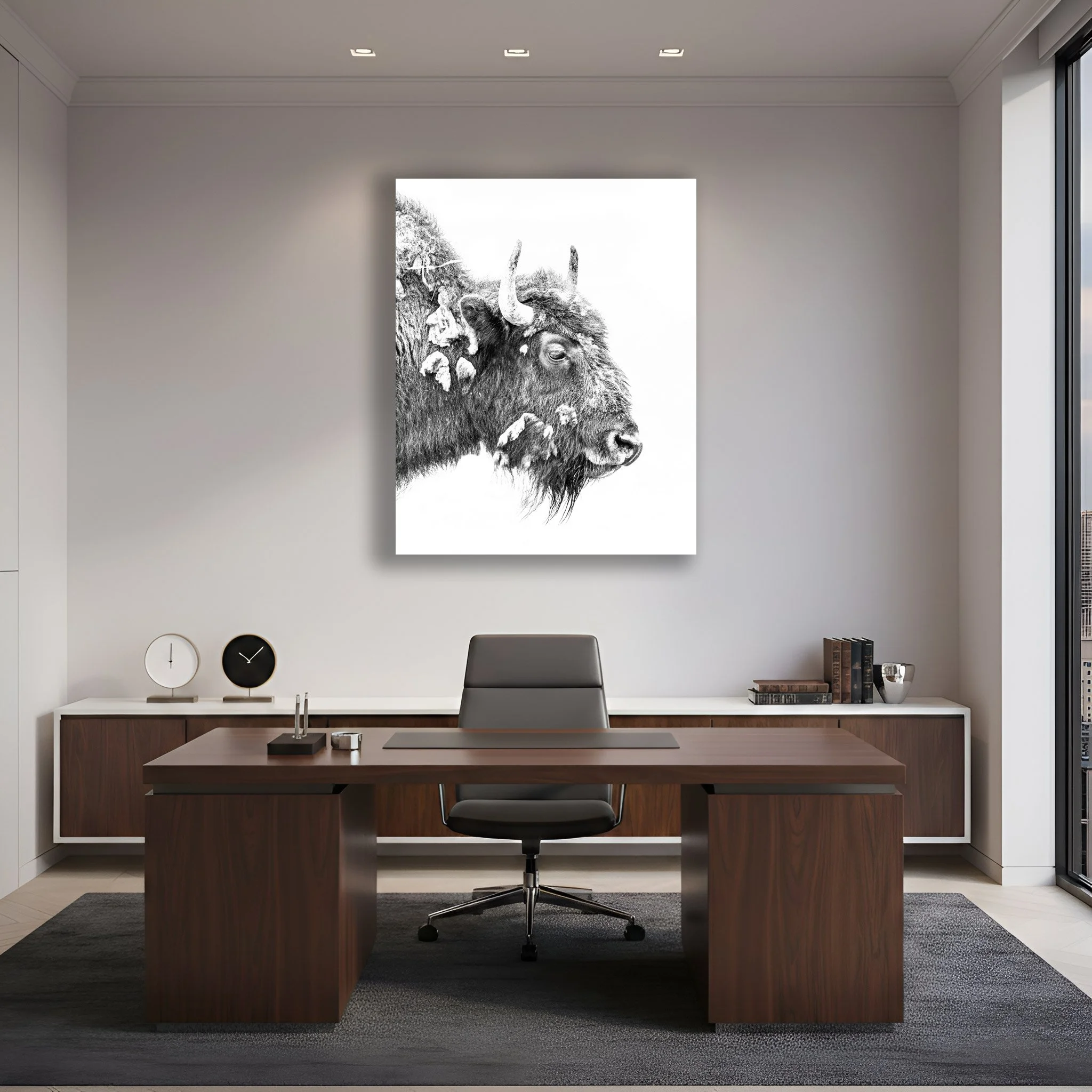
“Bison Bull” Part of the Quiet Sovereignty series of wildlife headshots. The high key imagery allows the piece to anchor the room without competing with existing decor.
There's a difference between art that decorates a wall and art that stops you mid thought. The first fills space. The second changes how a room feels the moment you walk in.
If you want your office to feel like a sanctuary rather than a showroom, move past the stock images. The predictable green forests, the generic coastal blues. Those images are forgettable because they were made to be. Luxury nature art invites you to look differently.
Three subject styles worth considering:
Macro Botanicals: Extreme close ups that transform a single leaf or mineral into something almost architectural. Nature turned abstract, precise and quietly breathtaking.
Aerial Landscapes: A coastline or a forest canopy seen from above becomes a living painting of shape and color. It rewards attention. The longer you look, the more you understand what you're seeing.
Minimalist Wilderness: High contrast black and white photography. A lone tree, a ridgeline in the fog, or a stretch of snow all can carry a stillness that anchors a room. It never overstates. It never goes out of style.
Medium and Material: Where Craft Becomes Quality
The image matters. But so does how it's made. Fine art doesn't live in a flimsy frame. Look for materials that reflect the care that went into creating the work:
Museum Grade Acrylic: Deep saturated color with a glass smooth finish that commands the wall. Feels gallery worthy and not mass produced.
Chroma-Luxe Metal: Vibrant colors with a sleek contemporary presentation that brings photos to life.
Fine Art Paper: Tactile and timeless, fine art paper brings a soft feel that pairs beautifully with natural wood furniture.
Placing Art with Purpose
Even the most powerful image can disappear on the wrong wall. Placement isn't an afterthought, it's part of the curation.
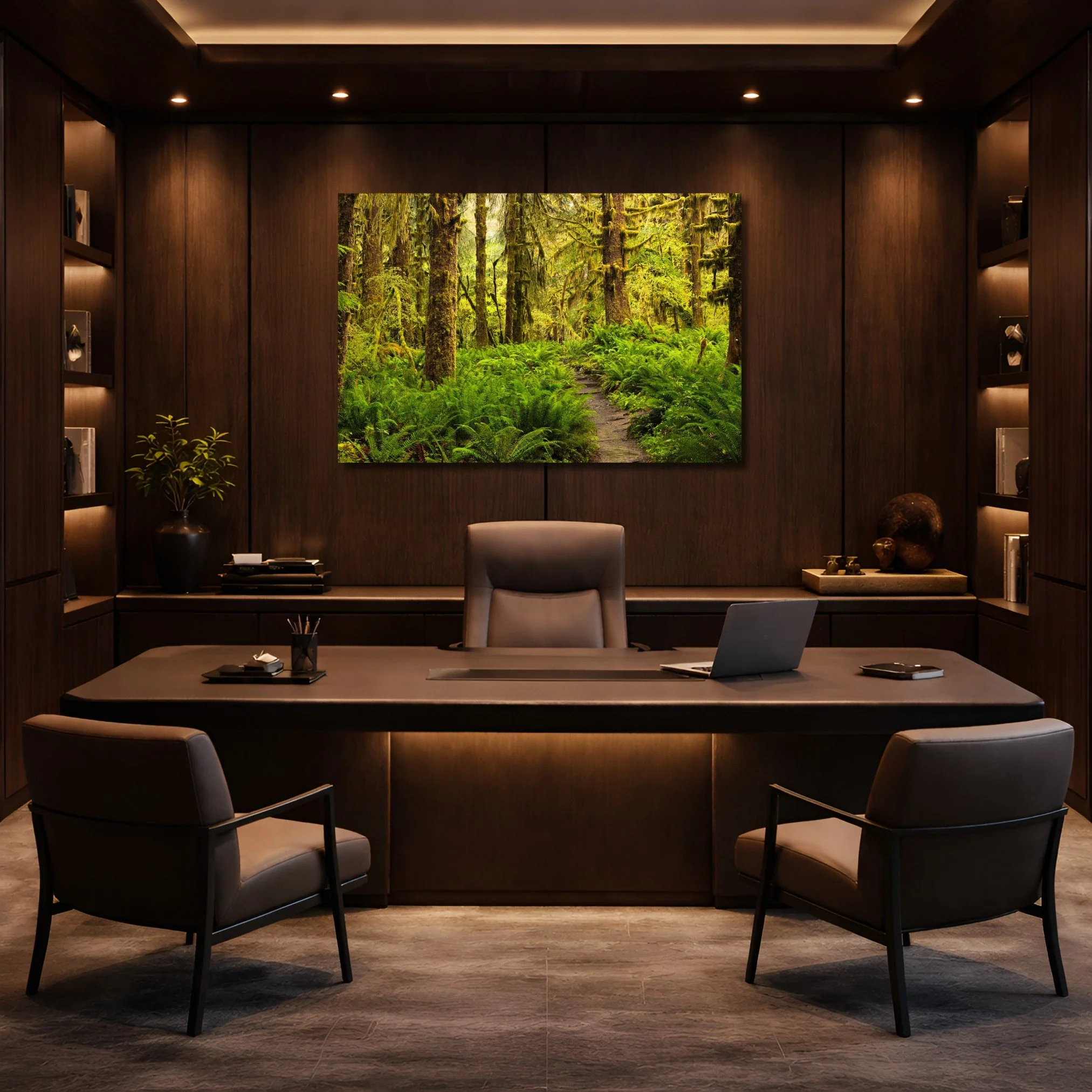
“Where the Forest Breathes” A trail leads though the rainforest in Olympic National Park. The biophilic aspects of this nature print bring peace to workspace.
The Wall Behind Your Desk
In a world of video calls, the wall behind you has become part of how the world sees you. A piece of nature art communicates something about who you are before you speak. Choose something that reflects the clarity you bring to your work.
Hang at Eye Level. Always.
The most common mistake is hanging art too high. Keep the center of your piece at eye level, roughly 57 to 60 inches from the floor. When art is properly grounded, the room settles. It feels intentional and everything breathes.
One Bold Statement or a Triptych?
A single oversized piece reflects you as confident and uncluttered. It says you know exactly what you want. A triptych, one image across three panels, brings rhythm to a wide wall without overwhelming it. Both work beautifully in an office space. The choice comes down to how you want the room to feel, decisive or expansive.
The Colors That Help You Think
Color isn't just decorative, it's physiological. The right tones change how you feel in a space and by extension how you work within it.
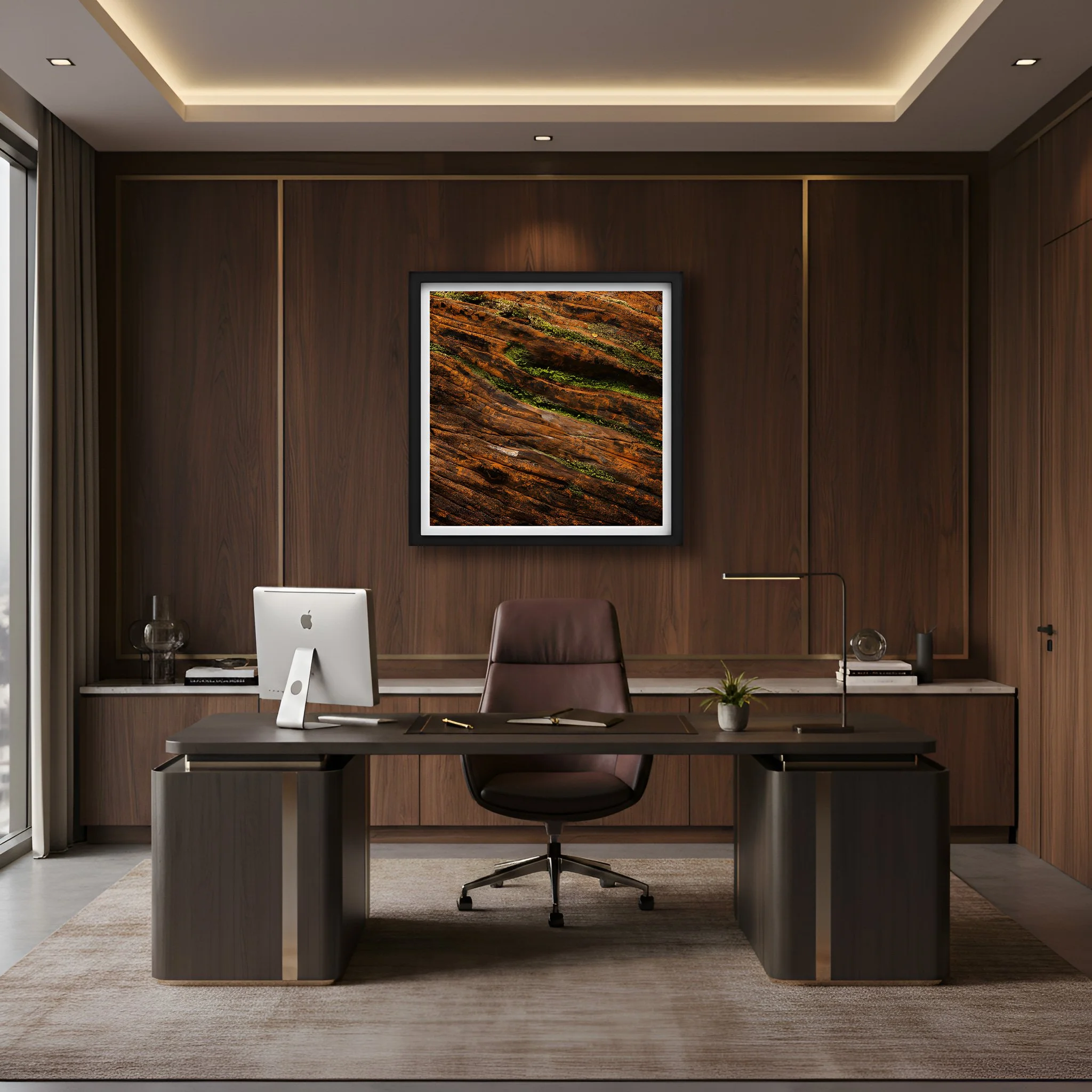
“Written by Time” A fine lines that only come with age of this weathered cherry tree. Earth tones in “Written by Time” make your office feel stable and grounded.
Green: Your Eyes Already Know
Green is the easiest color for the human eye to process. After hours of screen glare, a large piece of forest or moss toned art gives your visual system a place to rest. It's not passive, it actively restores your capacity to focus. This is exactly what a serious workspace demands.
Earth Tones: Grounded and Steady
Ochre, sands, and deep brown. These are colors that carry weight without heaviness. They make a room feel stable. When you work inside a space that feels grounded, your thinking follows. The decisions you make in that room feel steadier too.
Let the Art Speak to the Room
Great art doesn't exist in isolation, it converses with everything around it. Match your frame to the wood grain of your desk. Echo the metal finish of your lighting in the finish of your frame. When your art feels like it belongs, the whole room feels like it was designed by someone who pays attention.
The Finishing Details That Elevate Everything
There's a version of fine art that hangs on the wall and quietly disappears. Then there's a version that stops people when they enter the room. The difference is almost always in the details.
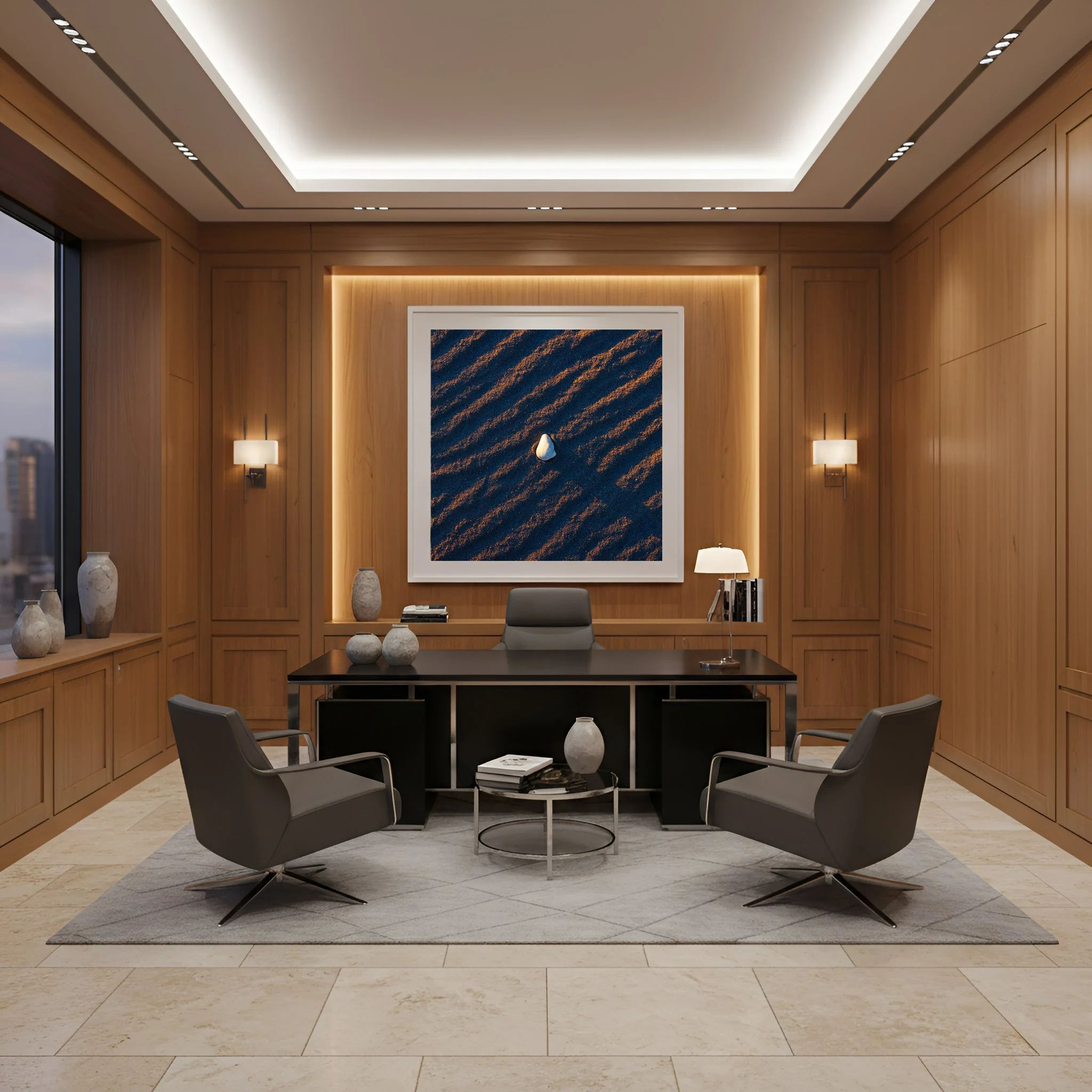
“Held by the Light” The sun rises on a single shell casting a long shadow. The mat surrounding “Held by the Light” gives the print room to breath and adds depth to the image.
Frame It Like a Gallery Would
The frame isn't an afterthought, it's part of the art:
Float mounts for metals and acrylics: a small gap between the image and the wall creates the illusion that the piece is hovering. Clean, modern, striking.
Deep set mats for fine art paper: that generous border of mat board between glass and image adds depth. It transforms even a quiet nature photograph into something museum worthy.
Light It Intentionally
Overhead office lighting is almost always wrong for art. It creates glare and flattens the colors. Dedicated picture lights, small lamps that cast a warm downward glow or recessed directional LEDs pointed at your piece will do something remarkable. These lights will make the colors come alive. They tell everyone in the room exactly where to look.
Layer in the Living World
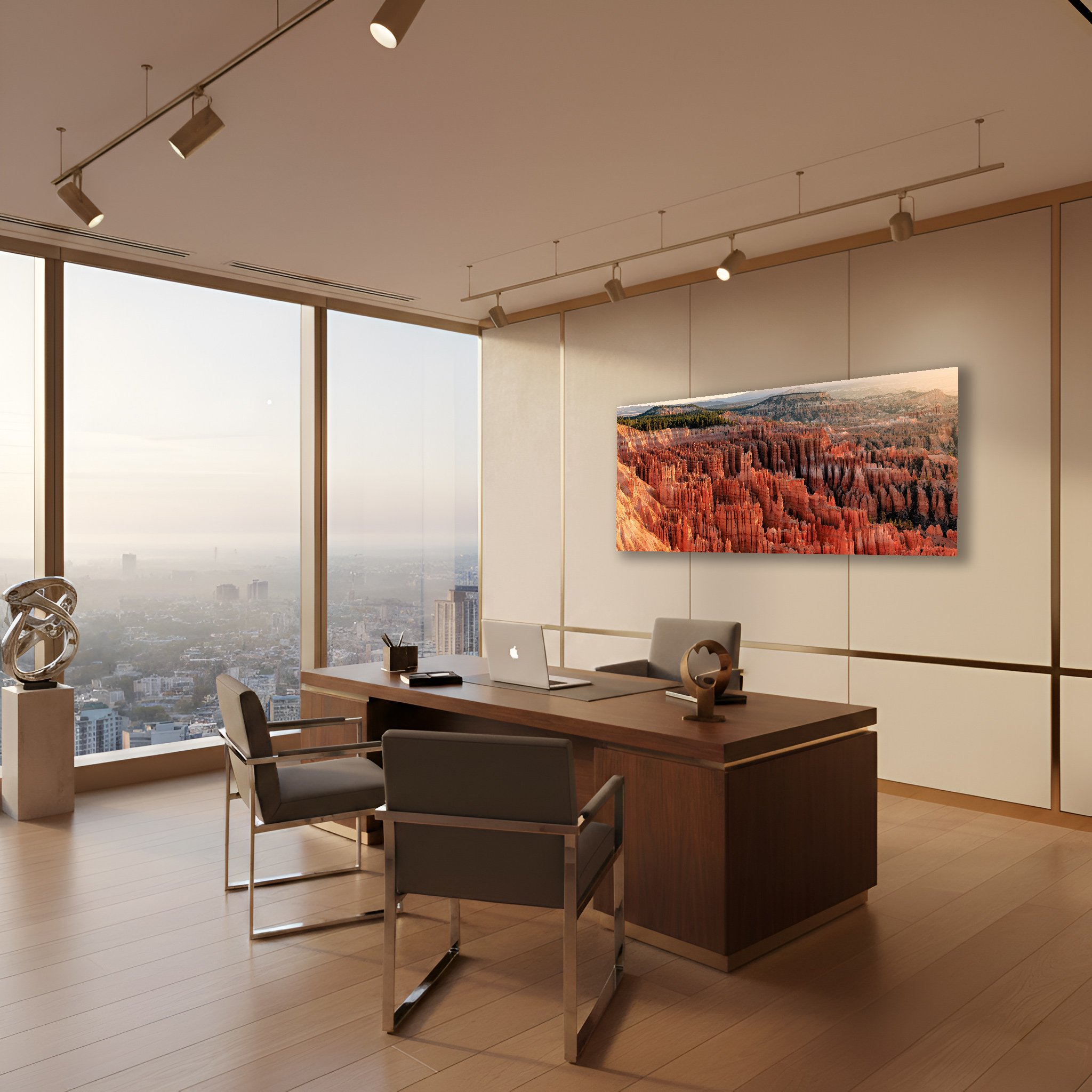
“Symphony of Stone” The sun rises over the hoodoos of Bryce Canyon National Park. Warm natural tones bring life to an otherwise dull office.
The truest expression of biophilic design doesn't stop at the wall. When art and real nature exist together in the same space, something shifts. The image on the wall and the plant in the corner begin to speak the same language. The room becomes an environment, not just a collection of objects.
Place a fiddle leaf fig beside a large forest piece. Set a bonsai or a single succulent on your desk near a smaller work. These aren't decorative gestures, they are continuations of the same idea. That you belong to the natural world, even here while working.
And let texture carry that conversation further. Soft, mossy landscapes pair with wool rugs and linen curtains. Rugged mountain photography looks completely at home beside leather and solid wood. When what you see on the wall echoes what you touch and sit in, the room stops feeling assembled, it feels alive.
Your Office as a Reflection of What You Value
The office you work in is not neutral. It either supports your best thinking or it quietly drains it. The walls either remind you why the work matters or they say nothing at all.
Styling your office with luxury nature photography is really about something simpler. Building a space that keeps you connected to the world that made you. When your environment is beautiful, grounded, and purposeful you show up differently. You think more clearly. You feel less scattered. You're reminded quietly every single morning of what actually matters.
That's worth curating.
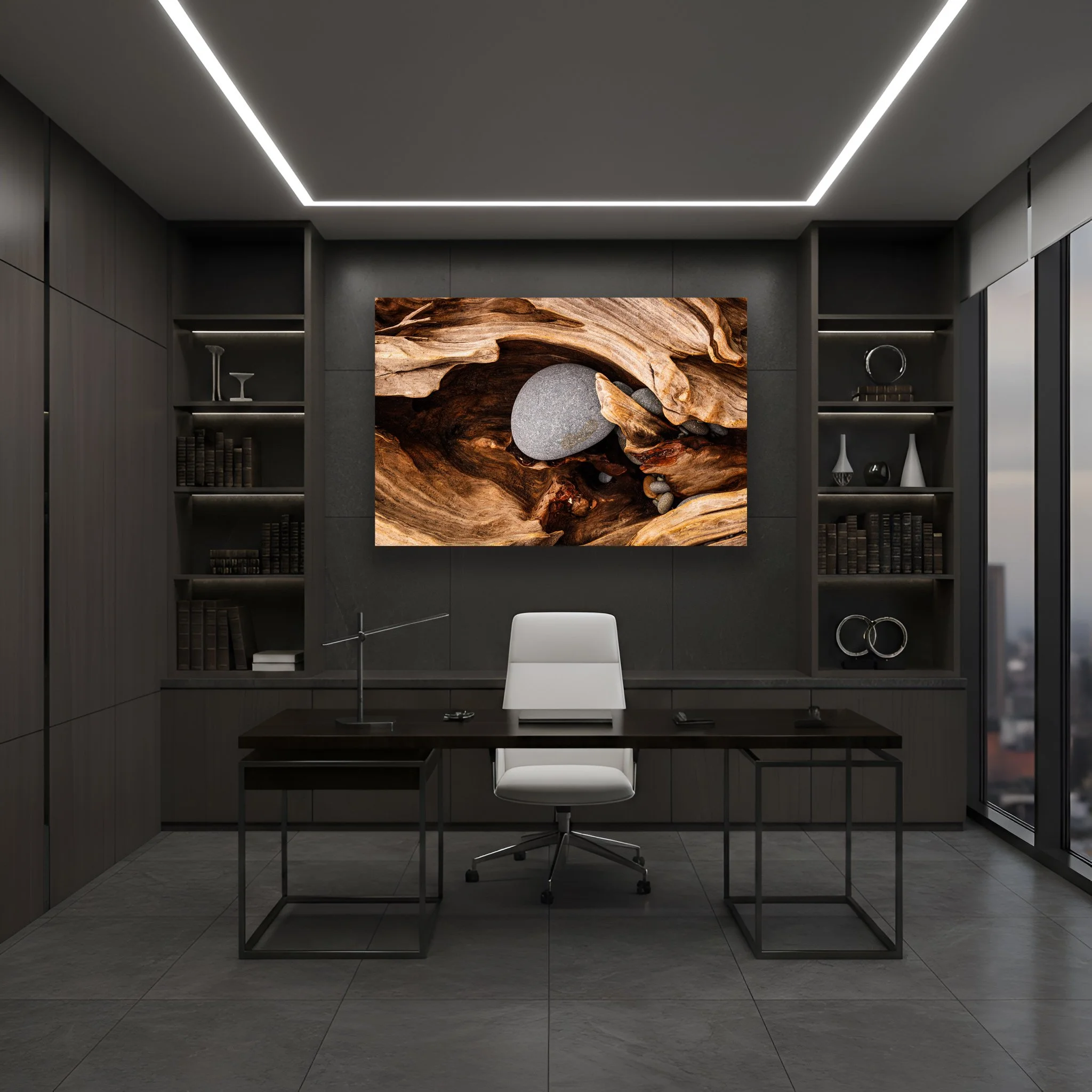
“Guardian’s Embrace” Driftwood that has washed ashore and been filled with rocks from the nearby surf. The warm earth tones contrast with the slate gray of the office bringing a piece of nature to an otherwise sterile environment.
About the Photo: Mother Road
The Great American Road Trip is more than just a drive. For many it’s a lifelong dream of discovery. An invitation to witness the vast landscapes and cultures that define this country. I’ve been fortunate enough to make the cross country trek twice, but the pull of the open road never fades.
In August of 2021, I had the privilege of taking my mother on the journey she had always dreamed of. Over 16 days and 6,253 miles, we navigated from Maryland through the heart of Chicago where we joined Historic Route 66. We followed that storied pavement all the way to the Pacific at Santa Monica. We returned home by interstates but were able to make stops at some beautiful National Parks.
While all of Route 66 was an amazing experience, Arizona captured our hearts. From the fallen giants of Petrified Forest to the overwhelming scale of the Grand Canyon, the state felt like a sanctuary of natural history. Yet the true soul of the trip lied in the Mother Road itself. The weathered charm of towns like Holbrook, Seligman, and Oatman. From old hotels and an abundance of roadside attractions to the wild donkeys, Arizona had it all.
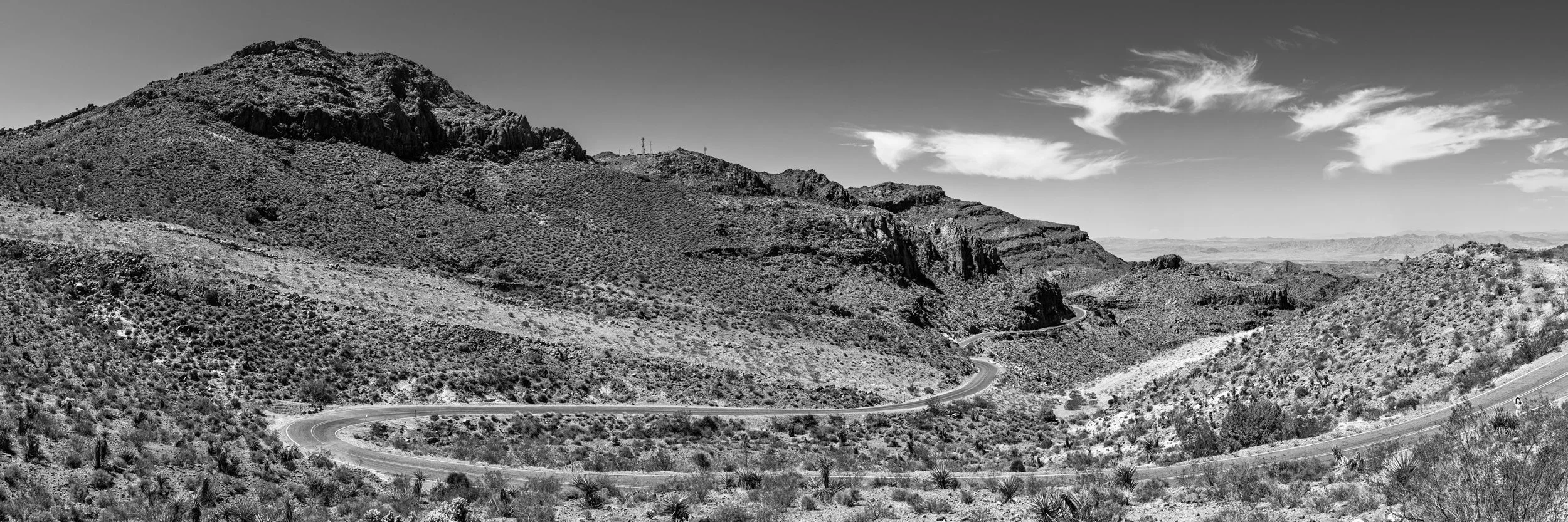
My personal highlight was the Oatman Highway as it climbed through Sitgreaves Pass. Known as “The Sidewinder,” this narrow eight mile stretch demands a slow pace. 191 curves hug the rugged terrain with drop offs on the side of the road.. Near the summit I found a vantage point that perfectly captured the road’s rhythmic descent toward Oatman. I was struck by how the pavement snaked through the desert. A narrow ribbon of humanity balanced against the dominant mountain peak.
Though the late morning light was starting to become harsh, the composition came together beautifully. The clouds in the upper right mirrored the silhouette of the mountains creating a natural balance. The road acts like a leading line taking your eye through the photo. Even after a few years, I still fine new details throughout the image. To capture the full grandeur of this scene, I stitched together seven individual frames into a panoramic vista.
I’d love to hear your thoughts on this perspective. Have you ever felt the pull of Route 66? If so, which stretch of the road stayed with you?
Transform Your Bedroom Into a Sanctuary with Nature Photography
Your bedroom should be more than a place to sleep. It should be your sanctuary, a refuge from the noise and demands of life. Too often our intimate spaces are filled with empty walls or mass produced decor that fails to move us, fails to inspire, and fails to bring the quiet power of nature into our lives.
There is a better way. Through the intentional use of fine art nature photography, you can create a restorative sleep sanctuary that not only elevates your space but reconnects you with the beauty of the natural world. This isn't simply about decorating. It's about designing an environment that serves your wellbeing. Designing an environment that reminds you to breathe and that brings you relief from the chaos of everyday life.
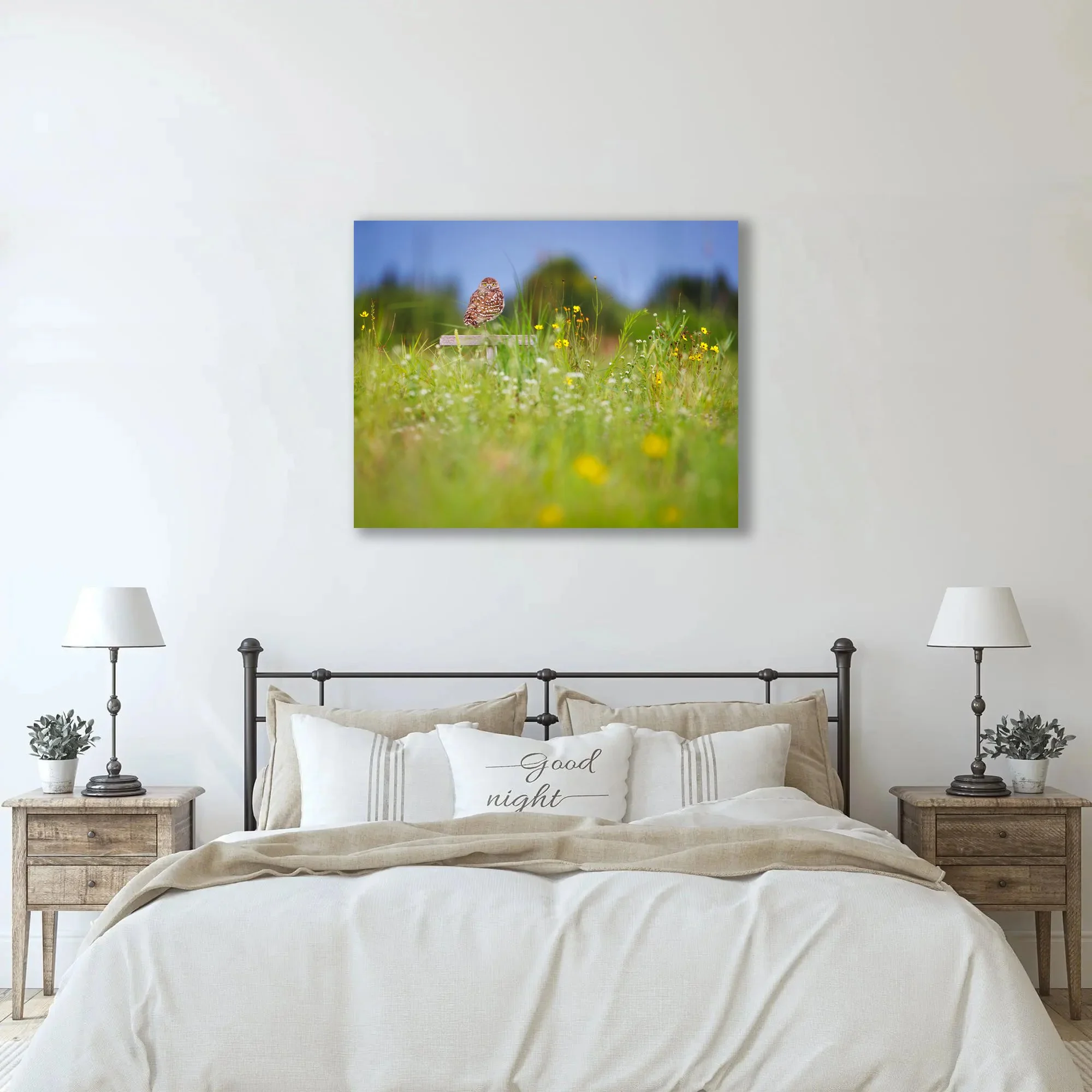
“Keeper of the Meadow” A burrowing owl sits perched looking for its next meal in the meadow. The warm amber and honey tones of the owl's plumage are intrinsically complementary to neutral linen, cream, and warm oak interiors.
Create a bedroom sanctuary through biophilic design, the practice of bringing nature indoors. With intentional nature photography in earth tones and calming palettes, you can design a space that quiets the mind, eases tension, and invites the deep, restorative sleep your body deserves.
Choosing Imagery That Speaks to Your Soul
Before you consider frames or placement, you must first choose photography that resonates with who you are. The images you select will transform the energy of your room the moment you enter. This is deeply personal work. Your bedroom is your sanctuary and the art within it should reflect what brings you genuine peace.
The Language of Color
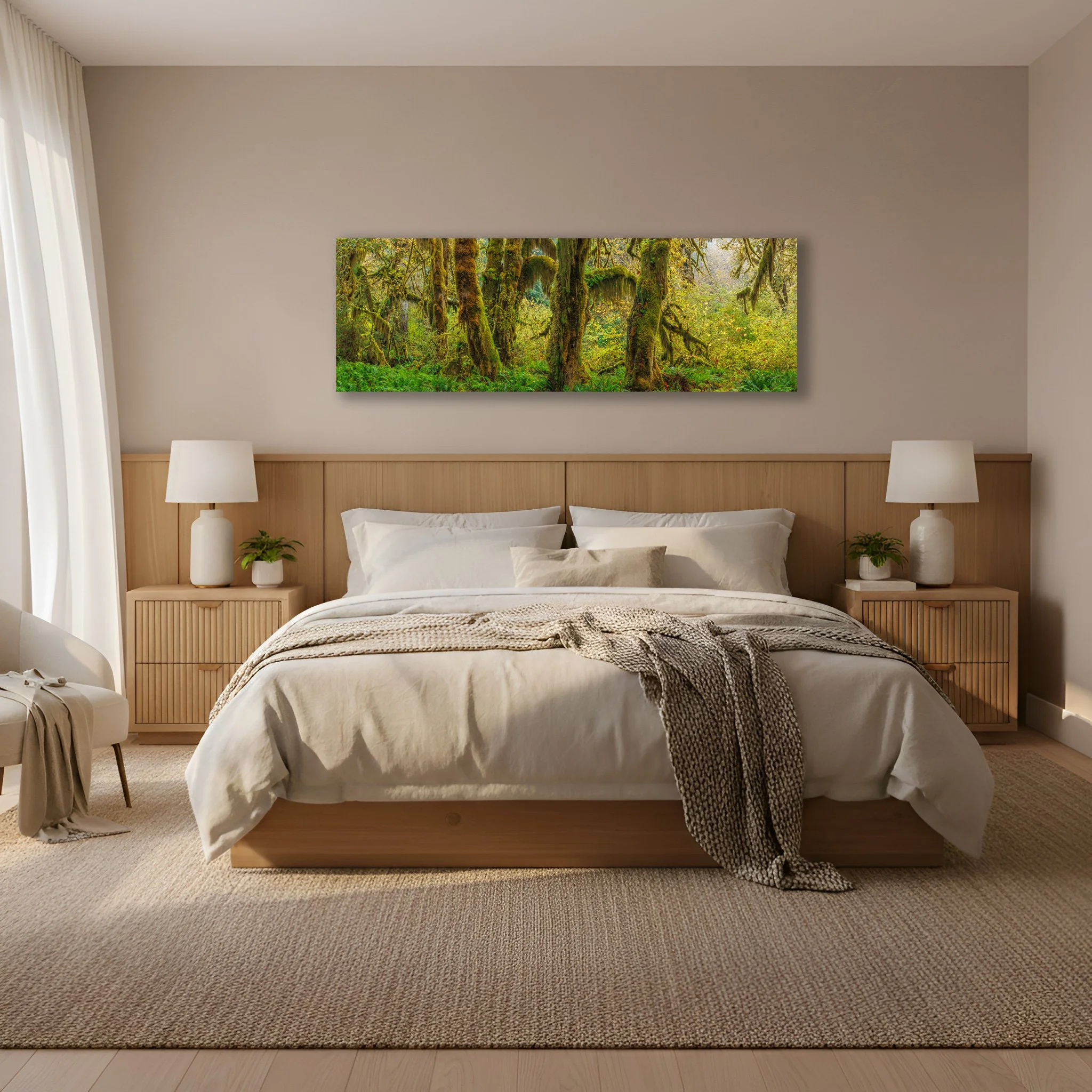
“Hall of Mosses” Lush emerald cathedral of moss draped maples in the Hoh Rainforest. “Hall of Mosses” biophilic design helps bring peace and relaxation to the bedroom.
Color has profound effects on our emotional state. In a bedroom, where rest and restoration are paramount, your palette matters.
Cool Tones for Deep Calm: Images of oceans, quiet lakes, and misty coastlines carry blues, teals, and soft greys. These colors are known to lower heart rate and invite deep relaxation. The visual equivalent of a long, slow breath.
Earth Tones for Grounded Warmth: If you seek a space that feels embracing and secure, look to forests and mountain landscapes. The greens, browns, and warm tans create a sense of being held by nature itself, a refuge from the outside world.
The Subject of Your Meditation
What appears in your photography is as important as its color.
Intimate Details: Macro photography like the delicate veins of a leaf or morning dew on a petal offers a meditative simplicity. These close observations quiet the mind and bring focus to the small wonders we so often overlook.
Expansive Vistas: Wide landscape views serve as visual windows, especially powerful in smaller bedrooms. They create the illusion of depth and openness, inviting your eyes to wander and your mind to expand beyond the walls that contain you.
Mastering Scale and Placement
Once you've chosen your imagery, thoughtful placement ensures your space feels intentional and harmonious. Poor placement, art hung too high, too small, or without consideration, disrupts the very tranquility you're seeking to create.
The Anchor Wall
The wall behind your headboard is the focal point of your bedroom. This is where your primary piece should live.
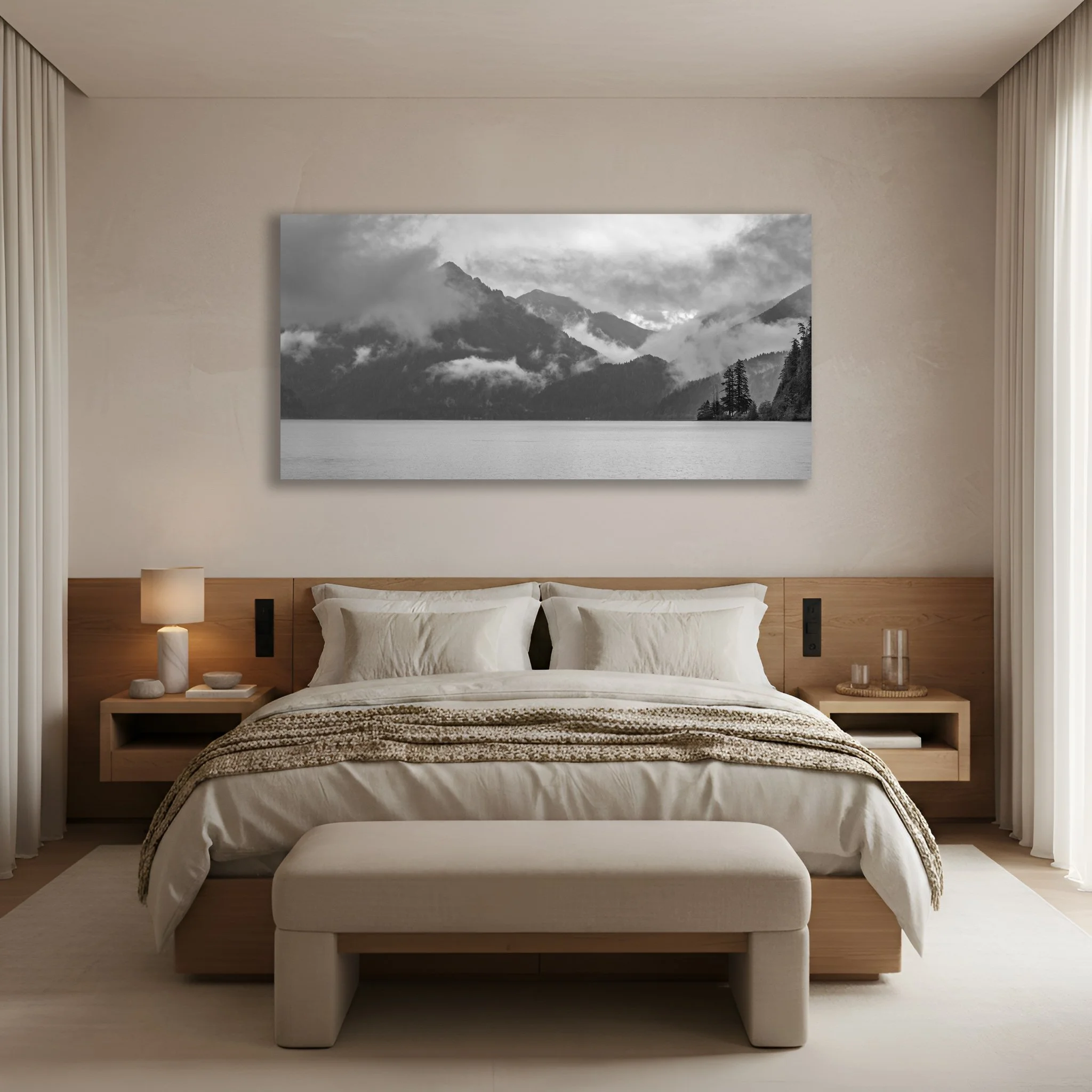
“Olympic Rains” Fog rises in the mountains above Lake Crescent in Olympic National Park. The calming etherial scene of “Olympic Rains” does not compete with color palettes allowing it to go with any room.
The Statement Piece: A single, substantial photograph commands attention with quiet confidence. It creates a sense of clarity and intentionality. Nothing extraneous, only what matters.
The Triptych: A three panel composition allows one image to unfold across your wall. This format offers visual interest while maintaining cohesion, particularly effective for panoramic landscapes that deserve room to breathe.
Proportions That Honor the Space
Your photography should be in dialogue with your furniture, not competing with it or lost against it. A general principle is that your wall art should occupy roughly 60% to 75% of your headboard's width. If your bed spans 60 inches, your photography should measure approximately 36 to 45 inches wide. This creates visual balance, the art and furniture exist in harmony, each honoring the presence of the other.
Height Considerations
Many people hang their art too high creating a disconnect. The center of your photograph should rest at eye level, but remember you experience your bedroom both standing and reclining. Position your work so you can appreciate it from your pillows while ensuring it doesn't feel cramped or overwhelming when you're moving through the space.
Framing That Honors the Natural World
The materials you choose for presentation should complement, not compete with your photography.
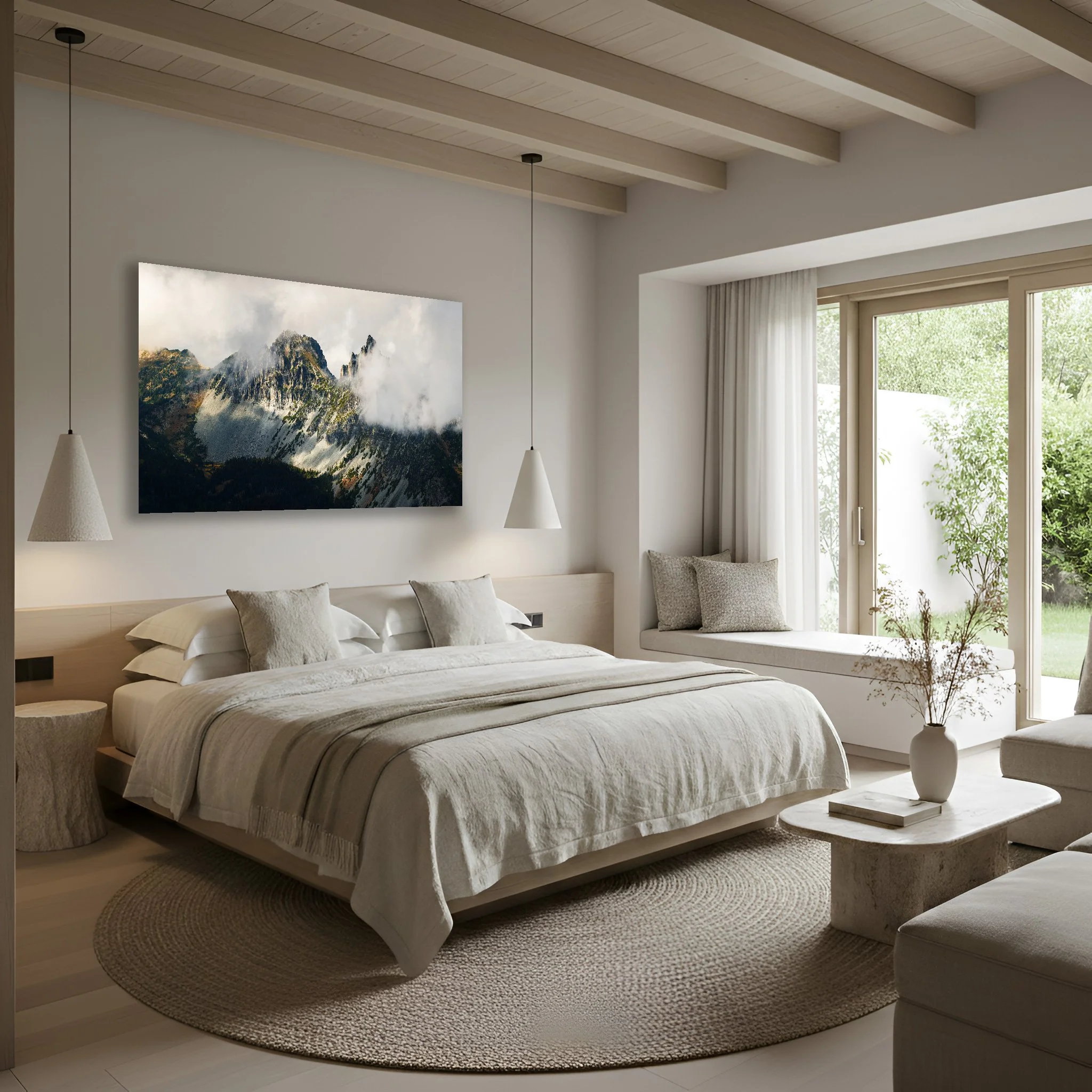
“Sluiskin’s Veil” The peak of Mount Sluiskin stands partially obscured by a wave of fog in Mount Rainier National Park. The atmospheric qualities of the fog lend to a calming mood in the bedroom.
Material Selections
Natural Wood: Frames crafted from oak or walnut bring warmth and organic texture. Since these frames originate from trees, they create an intuitive connection with forest and mountain imagery. This choice feels grounded, timeless, and reverent.
Metal Prints: Photography printed directly onto aluminum offers a sleek, contemporary presence. The material itself brings a subtle luminosity, particularly effective with water scenes and winter landscapes where that cool, crisp quality enhances the viewing experience.
Acrylic Prints: When photography is sealed behind substantial acrylic, colors take on remarkable depth and luminosity. The effect is almost dimensional as though you're looking through a window into another world. This is the closest you can come to bringing the wild directly into your space.
The Question of Matting
If you select traditional framing, consider whether you want matting, that border between image and frame.
A generous matte provides breathing room. It allows the photograph to exist without pressure, creating the refined presentation of gallery work. This choice speaks of intention and respect for the art itself.
Metal and acrylic prints typically forgo both matte and frame, floating on the wall with clean, minimal presence. This approach emphasizes the photography itself, nothing between you and the image.
For warmth and tradition, choose wood with matting. For contemporary clarity and vibrant color, consider metal or acrylic.
Creating Harmony with Your Environment
Your photography shouldn't simply occupy wall space, it should be in conversation with every element of your room.
Textural Dialogue
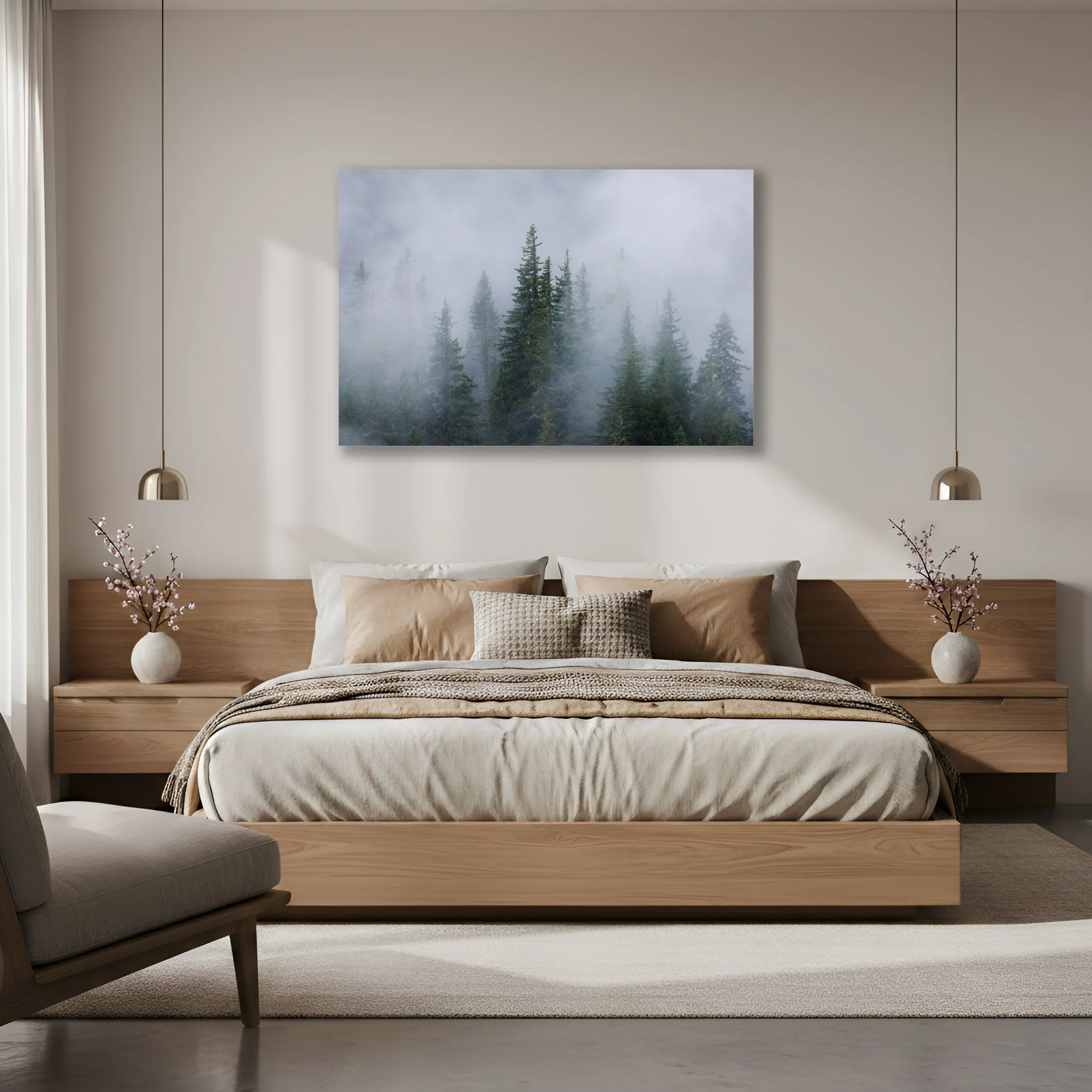
“Evergreen Dreams” Fog moves in and out of an evergreen forest in the Pacific Northwest. “Evergreen Dreams” muted grey and green tones along with meditative verticals brings a deeply calming mood to your bedroom.
The textures in your space can echo the qualities of your photography. A misty forest photograph pairs beautifully with soft wool throws or linen bedding. The tactile softness mirrors the visual softness, creating a cohesive sensory experience that deepens the sense of sanctuary.
Lighting Considerations
Light transforms photography, for better or worse.
Museum Glass: If your photograph faces a window, standard glass will create glare that obscures your image. Museum grade non reflective glass solves this, allowing you to appreciate the full depth and detail of the photograph regardless of natural light.
Warm Ambient Light: Most nature photography reveals its full character under warm lighting. Bedside lamps with warm toned bulbs enhance the golden hour quality of landscape work, making your space feel more inviting as evening settles in.
Consider your photography as the foundation for your room's palette. If your image carries rich forest greens, introduce that color elsewhere in textiles, in ceramics, in small intentional touches that create visual flow throughout your sanctuary.
Your Personal Window to the Wild
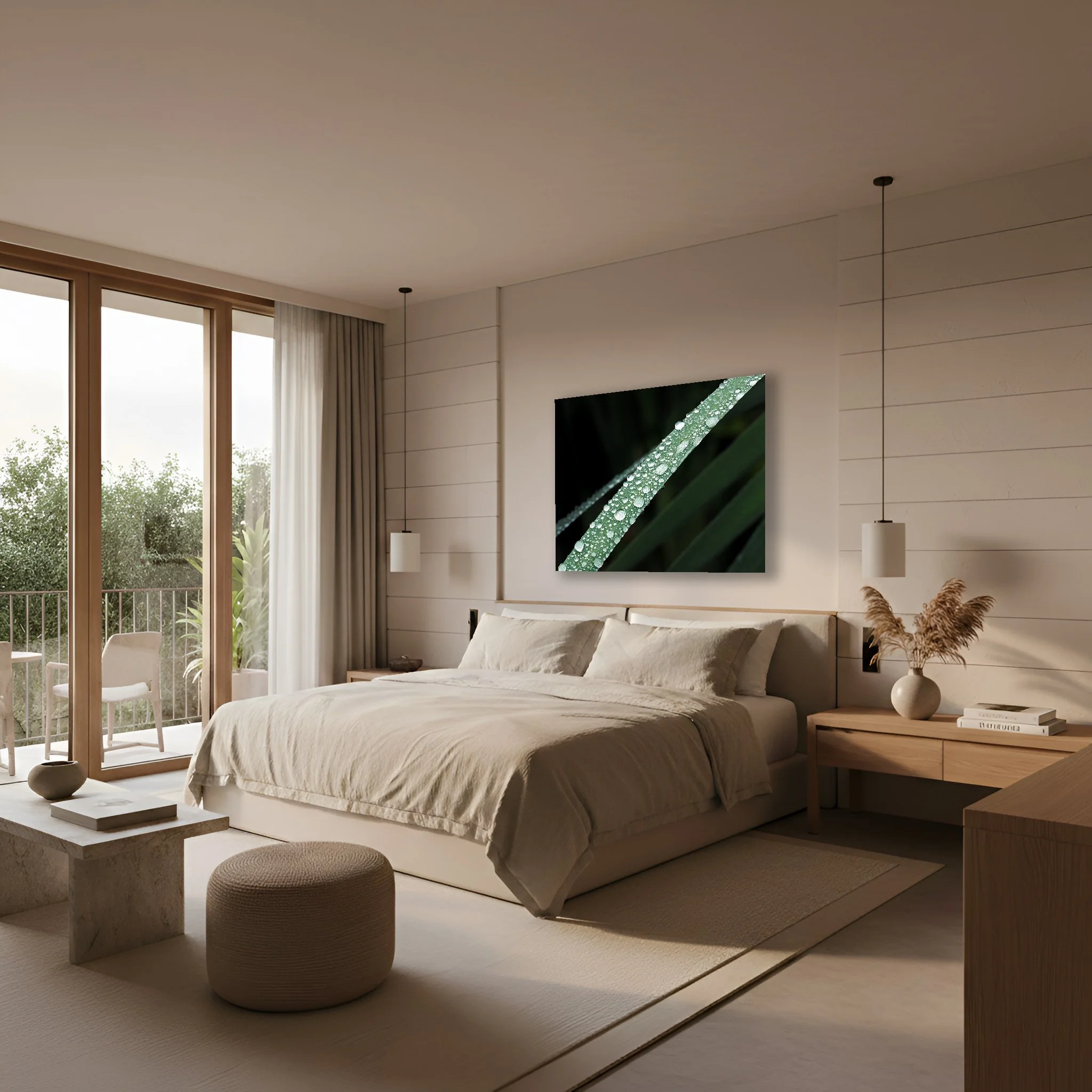
“Bejeweled” Intimate shot of beads of rain sitting on a single blade of grass. The intimacy of the shot is perfect for the bedroom or a spa environment.
You've learned about color theory, proportions, and materials. But the most important consideration remains. This is your sanctuary. Your bedroom is both your last sight before sleep and your first view upon waking up. Make certain it's a view that genuinely nourishes you.
Choose Your Calm
Remember that tranquility means something different to each of us. For some peace arrives with the rhythmic crash of ocean waves. For others it's found in the profound silence of mountain peaks or the filtered light of deep forests.
Don't select photography simply because it coordinates with your existing decor. Choose landscapes that genuinely move you, that make you pause, that invite that deep, centering breath. If an image brings you peace, it belongs on your wall.
Design for Restoration
Decorating with intention isn't about aesthetics alone. When you're thoughtful about what surrounds you, particularly in your most private and vulnerable space, you're actively supporting your own wellbeing. By bringing the wild indoors, even in curated form, you create a daily reminder to slow down, to notice beauty, and to reconnect with what matters.
A bedroom designed as a true retreat doesn't just look different. It changes how you rest, how you wake, and how you move through your days. This is the power of living with meaningful art. It transforms not just your space but your life within it.
How to Choose Luxury Nature Wall Art for a Living Room: A Deeper Approach to Creating a Sanctuary
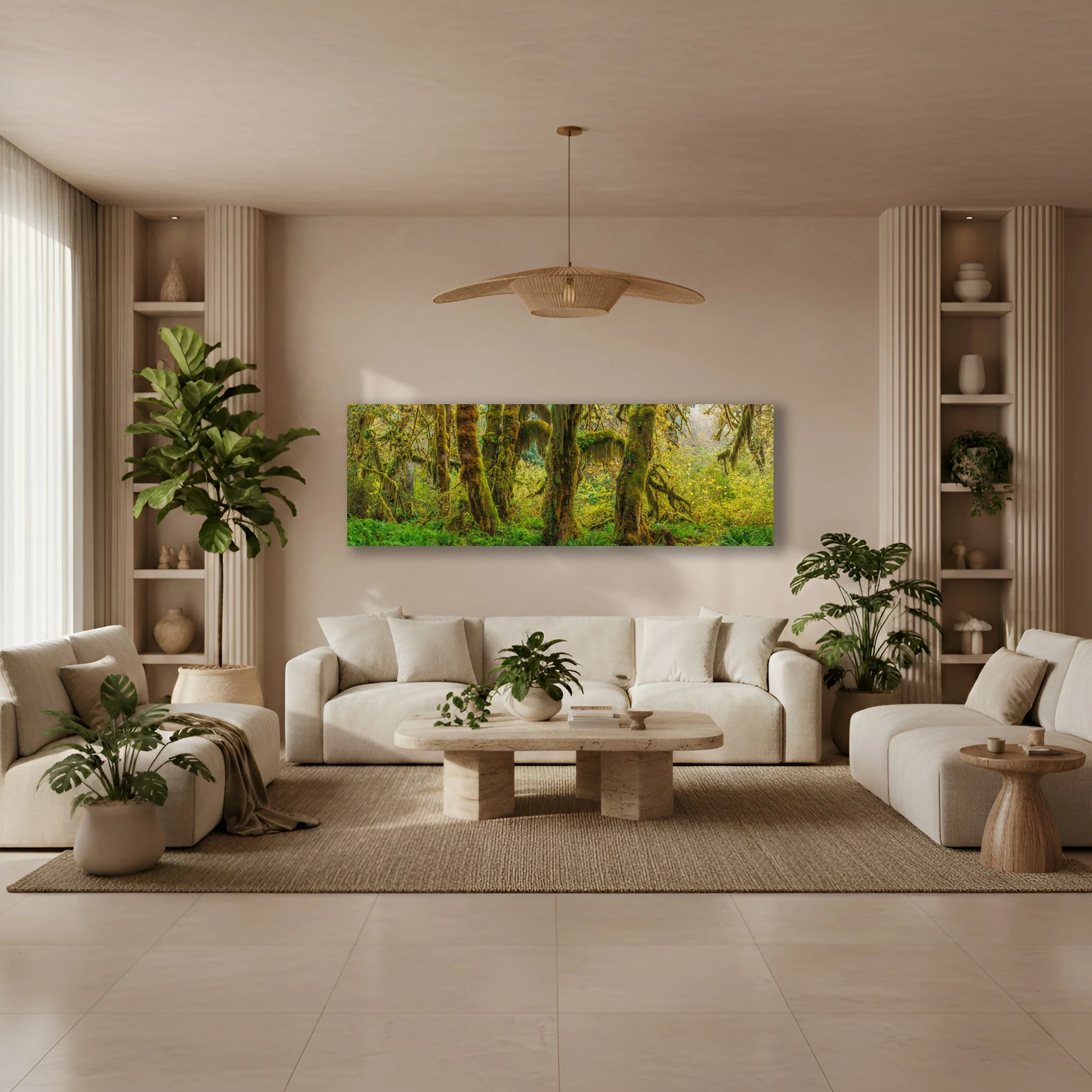
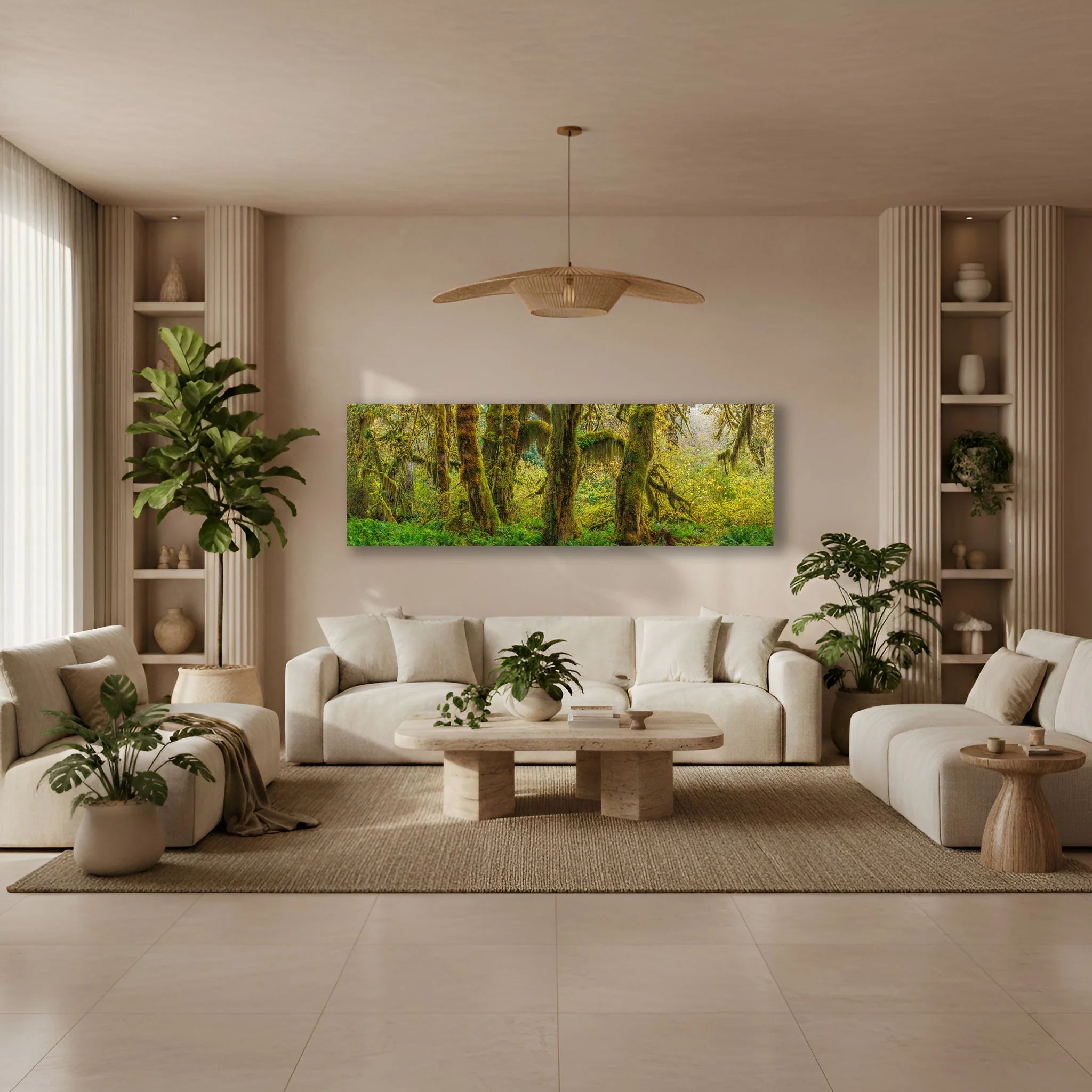
“Hall of Mosses” The lush emerald cathedral of moss draped maples in the Hoh Rainforest. “Hall of Mosses” is perfect for clients searching for nature immersive interiors and biophilic design.
Your living room walls hold more potential than most people realize. They're not just empty space waiting to be filled, they're an opportunity to create the kind of sanctuary we all desperately need in our increasingly disconnected world. If your walls are still blank, or worse, filled with mass produced decor that fails to move you, the space feels unfinished.
The question isn't just about finding art that matches your furniture. It's about discovering a piece that stops you in your tracks, that reminds you to breathe and reconnects you with the extraordinary beauty of the natural world. When you're ready to invest in museum quality nature photography, you deserve to approach the decision with intention and clarity.
The Quick Guide: Choosing Living Room Art
Location: Anchor the art over the sofa or fireplace as a primary focal point.
Scale: Aim for the piece to cover 60-75% of the wall space above your furniture.
Materials: Stick to archival, museum grade finishes like acrylic or framed fine art paper.
Vibe: Ensure the piece’s energy (calm vs. dramatic) matches how you want the room to feel.
Why Your Living Room Deserves More Than Filler
We live in a world that is increasingly loud, fast, and disconnected from nature. Our homes should be our refuge from all of that noise. Yet too often, our walls are filled with soulless decor that we barely notice. Art that is chosen more for convenience than connection.
The photographs you bring into your space aren't just for decoration. They become part of the atmosphere you breathe every single day. A calm forest scene invites stillness. A dramatic ocean wave brings energy. The images surrounding you shape how you feel in your own home. This is why choosing the right piece matters so deeply.
Finding the Soul of Your Space
Every room has a natural focal point, a place where eyes land the moment someone walks through the door. In most living rooms, this is the wall above your sofa or the space above your fireplace. This is where your art belongs.
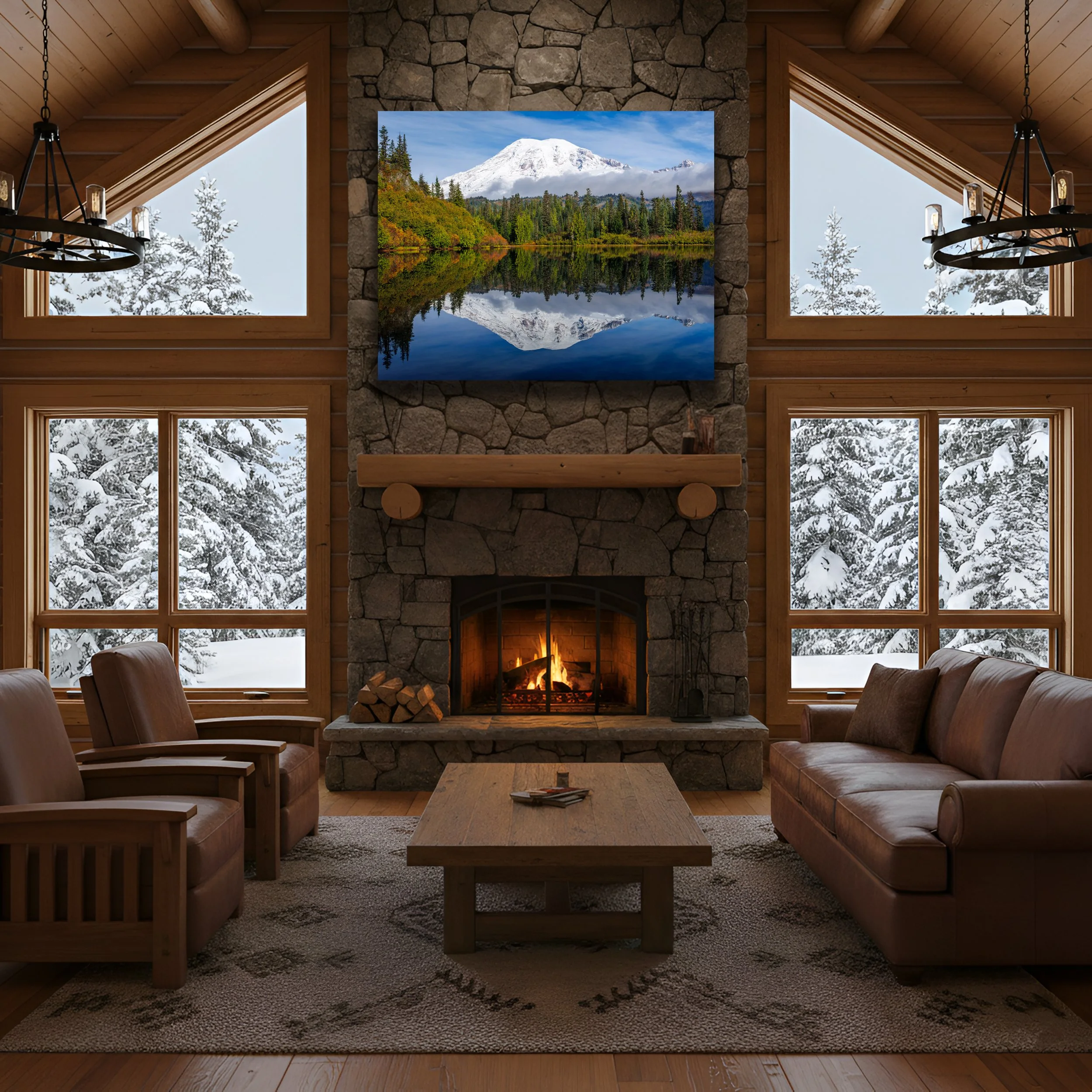
“Tahoma” A snow capped Mount Rainier stands reflected in the calm waters of Bench Lake. Acrylic print sitting above a stone fireplace in a mountain cabin. “Tahoma” with its classic triangular composition makes it a highly effective anchor piece bringing a composed and inviting mood.
Think of it as the anchor that holds the entire room together. When you place a powerful nature print in this position, it sets the emotional tone for your entire home. It becomes the thing people remember, the thing that makes them feel something.
But placement goes beyond just picking the obvious wall. Consider the architecture of your room, the bones of the space:
If you have high ceilings, a vertical piece helps fill that upward space and prevents the room from feeling bottom heavy. If you have large windows, placing your photograph on the opposite wall lets natural light illuminate the image, creating a beautiful dialogue between the wild outside and the wild captured in the frame. Even small alcoves and corners can become intimate galleries with the right piece. A smaller, highly detailed nature print that invites you to pause and really look.
The Truth About Scale
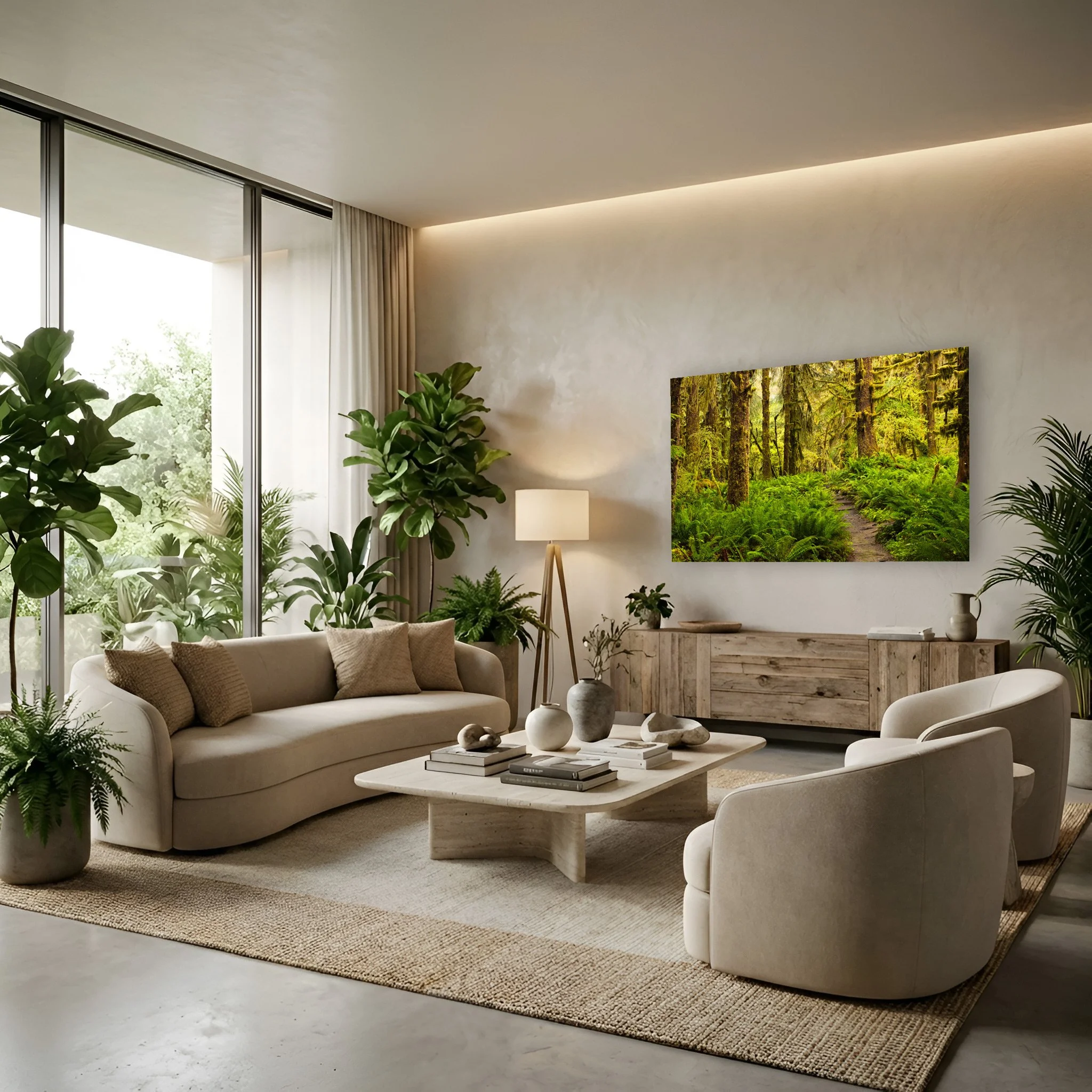
“Where the Forest Breathes” A trail leads through the lush ferns and trees of the Hoh Rainforest. “Where the Forest Breathes” is a biophilic work that is highly versatile and complimentary of many room types and designs.
Here's something most people get wrong, they choose art that's too small.
Don’t Make the “Postage Stamp” Mistake
There's a common mistake in design, hanging a tiny print in the middle of a vast wall creating what we call the "postage stamp" effect. It makes the entire space feel unfinished, even if the photograph itself is beautiful.
Luxury isn't about expense. It's about presence. Your nature photography needs to command attention, to feel like an integral part of the room's architecture rather than an afterthought.
The Secret Math
The guiding principle is simple, your art should cover roughly 60-75% of the width of the furniture beneath it. If your sofa is 100 inches wide, your photograph should be around 60 to 75 inches across. This creates balance and gives that sense of completion you're looking for.
You can achieve this with a single grand format print, one powerful window into nature, or with a diptych or triptych. This is where the image is split across multiple panels or by having multiple complementary prints sharing the space in harmony. Both approaches work beautifully, it simply depends on whether you want bold simplicity or creative breathing room.
Matching Energy to Purpose
Choosing a photograph isn't just about selecting a piece of a place you find beautiful. It's about choosing an energy that aligns with how you want to feel in your space.
Playing with Color
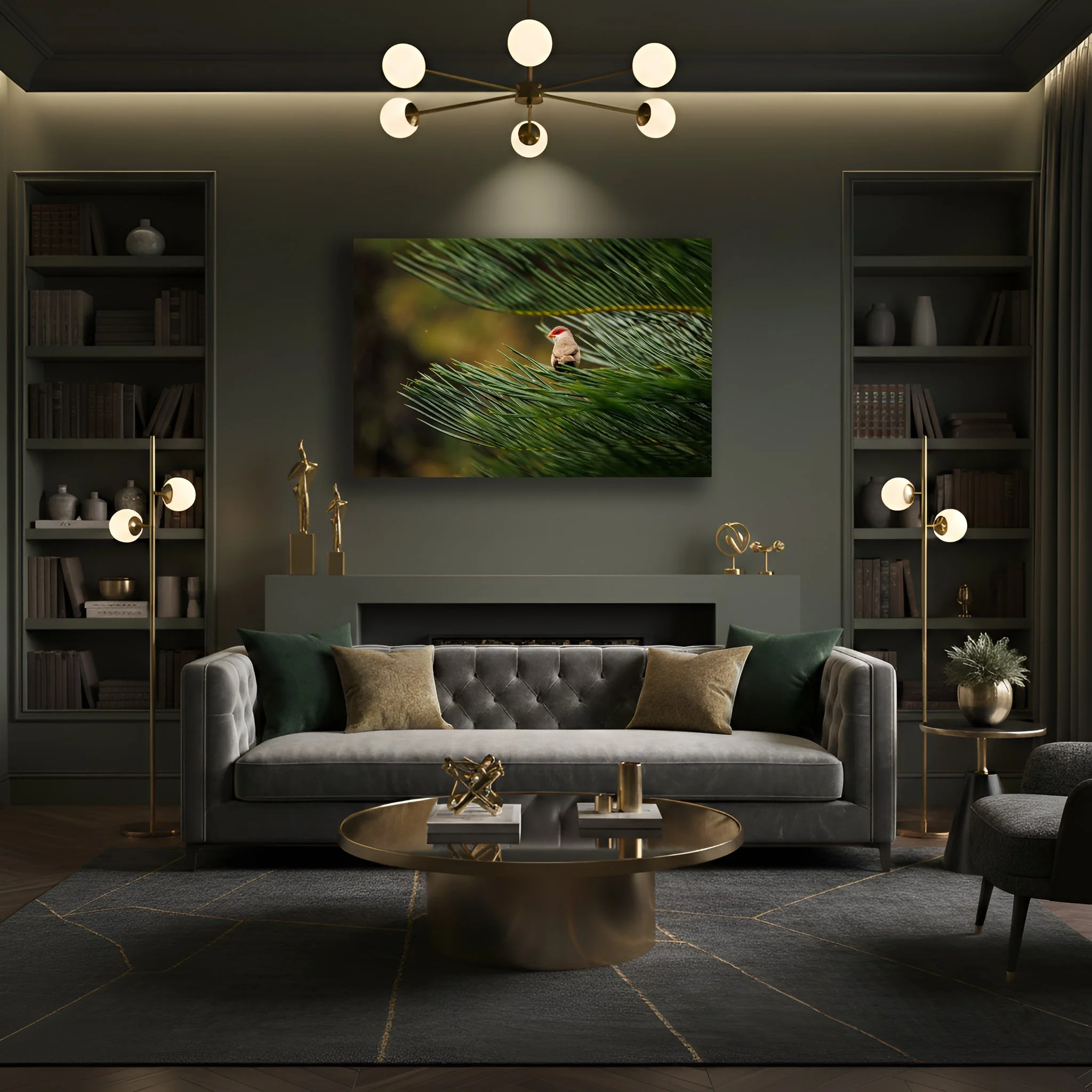
“Bird in Paradise” A common waxbill sits perched on a dark green branch. “Bird in Paradise” demonstrates choosing a print that is cohesive with the surrounding room and complimentary of the other decor.
Consider the colors already present in your room. You can approach this in two ways, cohesion or contrast.
A cohesive approach means selecting imagery with colors that echo what's already there. Blues that mirror your throw pillows or grays that complement your sofa. Everything blends together for a sense of calm and professional polish.
Contrast on the other hand is when you introduce something unexpected. A vibrant green forest in an otherwise neutral room creating a visual anchor or “pop” that brings the room to life.
The Feeling
Nature photography changes how a room feels. Think about the emotion you want when you sit down to relax:
Bright, airy coastal scenes and minimalist deserts create openness. They make rooms feel larger, cleaner and more breathable. These are perfect for spaces meant for gathering and conversation.
Moody dramatic imagery like misty forests at dawn or jagged mountain peaks under stormy skies brings depth and sophistication. These photographs create intimacy making rooms feel cozy, expensive and contemplative.
For modern interiors, abstract natural textures work beautifully. This could be the patterns in wind blown sand or the bark of ancient trees. These pieces blur the line between fine art and nature photography, offering something that feels both organic and refined.
When Luxury Carries Purpose
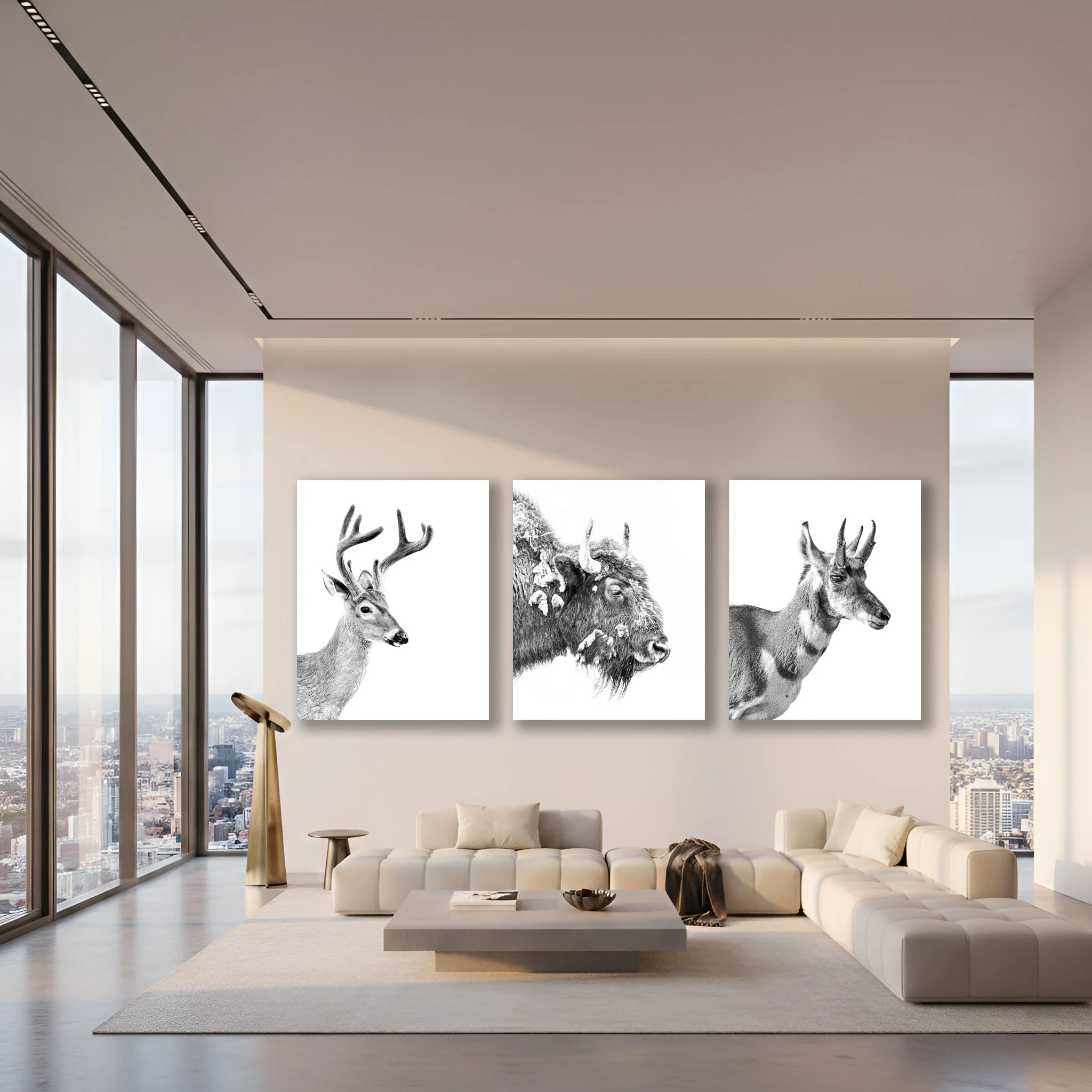
“Whitetail Buck,” “Bison Bull,” and “Pronghorn Buck” Part of the Quiet Sovereignty series, these portraits sit on a gallery wall in a penthouse sitting area. High key portraits of wildlife that look refined and gallery ready.
True luxury isn't just about beauty, it's about meaning. The nature photography you bring into your home can do more than elevate your space. It can contribute to the protection of the very landscapes and wildlife it portrays.
When you choose work that supports conservation, every glance at your walls becomes a quiet affirmation of your values. You're not just creating a beautiful environment, you're participating in something larger than yourself. The photograph becomes a reminder of what we stand to lose if we don't act, and what we gain when we choose to protect the wild places that still exist.
This is the kind of luxury that resonates deeply. It's the tranquility of the natural world brought indoors, paired with the knowledge that your investment supports the ongoing fight to preserve these places for future generations. The beauty you protect becomes the beauty you live with.
When carefully chosen, nature photography doesn't just fill a wall. It creates a retreat within your home. A moment of calm in the chaos, a touch of wonder that stops you in your tracks, a daily reminder to slow down and breathe.
Materials That Honor the Image
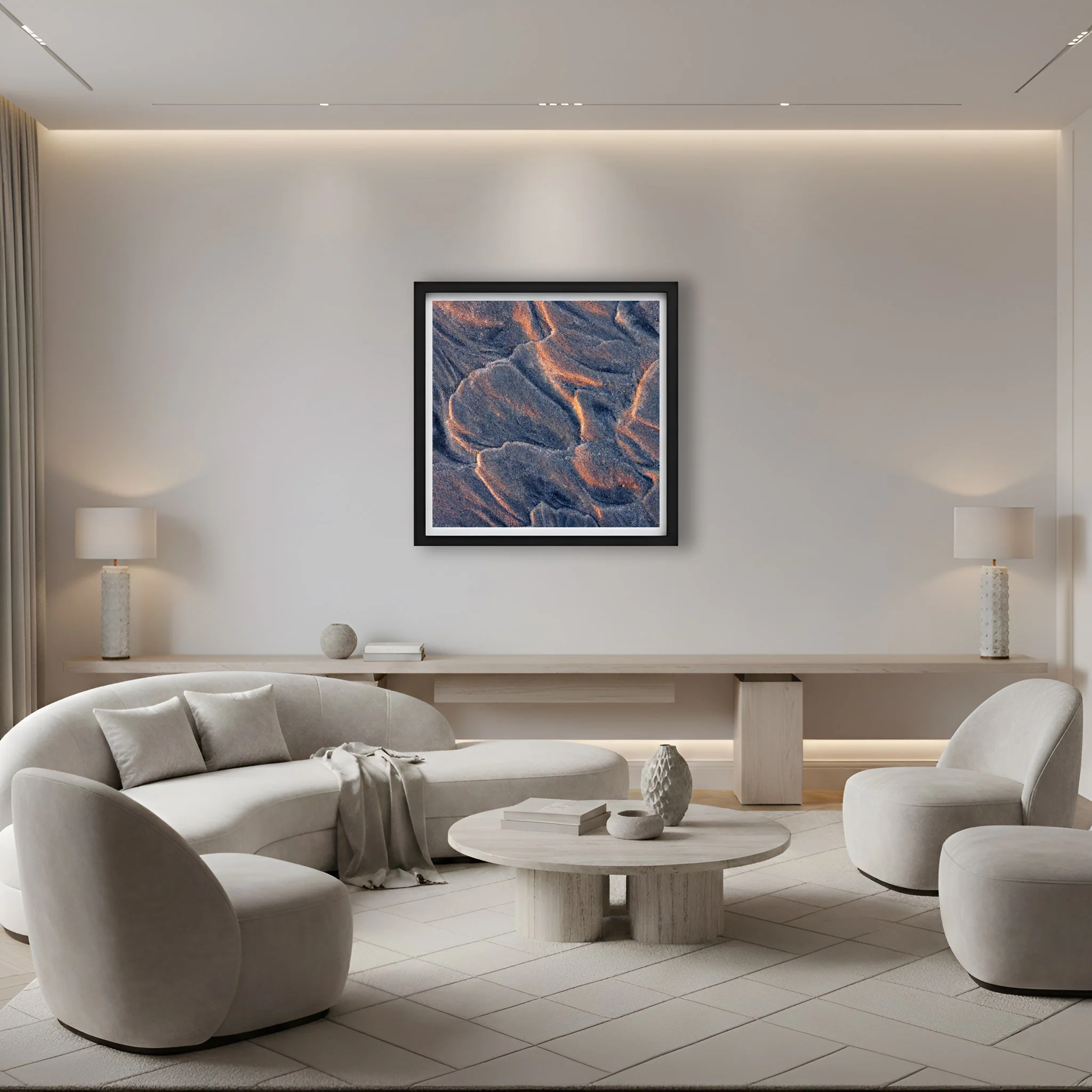
“After the Tide” The setting sun illuminates subtle ridges in the sand. “After the Tides” soft natural lines in the ridges of sand mirror the sweeping lines of the furniture.
The medium you choose is just as important as the photograph itself. This is where luxury reveals itself, not in the price tag, but in the way light interacts with the piece, in the way the image holds its presence over time.
Museum Grade Acrylic offers offers extraordinary depth. The photograph is sealed behind a layer of clear acrylic, creating vivid colors that feel three dimensional. There's no frame around the image. The photo floats on the wall with clean, modern elegance. This is the goto choice for rooms with contemporary lines and minimalist sensibilities.
Metal Prints bring a unique luminosity. The image is infused directly into aluminum, creating colors that seem to glow from within. These prints are remarkably durable. Metal prints are waterproof and scratch resistant, making them ideal for homes in humid climates or high traffic areas. Like acrylic prints, metal prints float frameless on the wall, offering a sleek, industrial aesthetic.
Framed Fine Art Paper is the timeless classic. The photograph is printed on museum quality archival paper, surrounded by a mat, and placed within a carefully chosen frame. This approach feels warm and sophisticated, perfect for spaces with traditional elements such as bookshelves, area rugs, and classic furniture. It speaks to craftsmanship and permanence. One detail that separates truly exceptional pieces is anti reflective glass. You've probably experienced the frustration of looking at a framed photograph only to see the reflection of a lamp or window. Museum quality glass is so clear it becomes nearly invisible, allowing you to see every detail from any angle in the room. This matters more than most people realize.
Light as the Final Element
Even the most beautiful photograph needs proper lighting to truly come alive. Natural light can be stunning, it makes landscapes glow with authenticity but it requires care. Direct sunlight contains UV rays that fade colors over time, even with archival inks. Ideally, position your photograph where it receives indirect light rather than harsh, all day sun exposure.
For a gallery quality presentation, consider dedicated lighting. Picture lights mounted above the frame create a warm, focused glow that makes the piece feel important and valued. Ceiling mounted wall washers, the kind museums use, provide even illumination that makes the photograph appear to glow from within.
When lighting is done right, your nature photography becomes the first thing people notice when they enter the room, day or night.
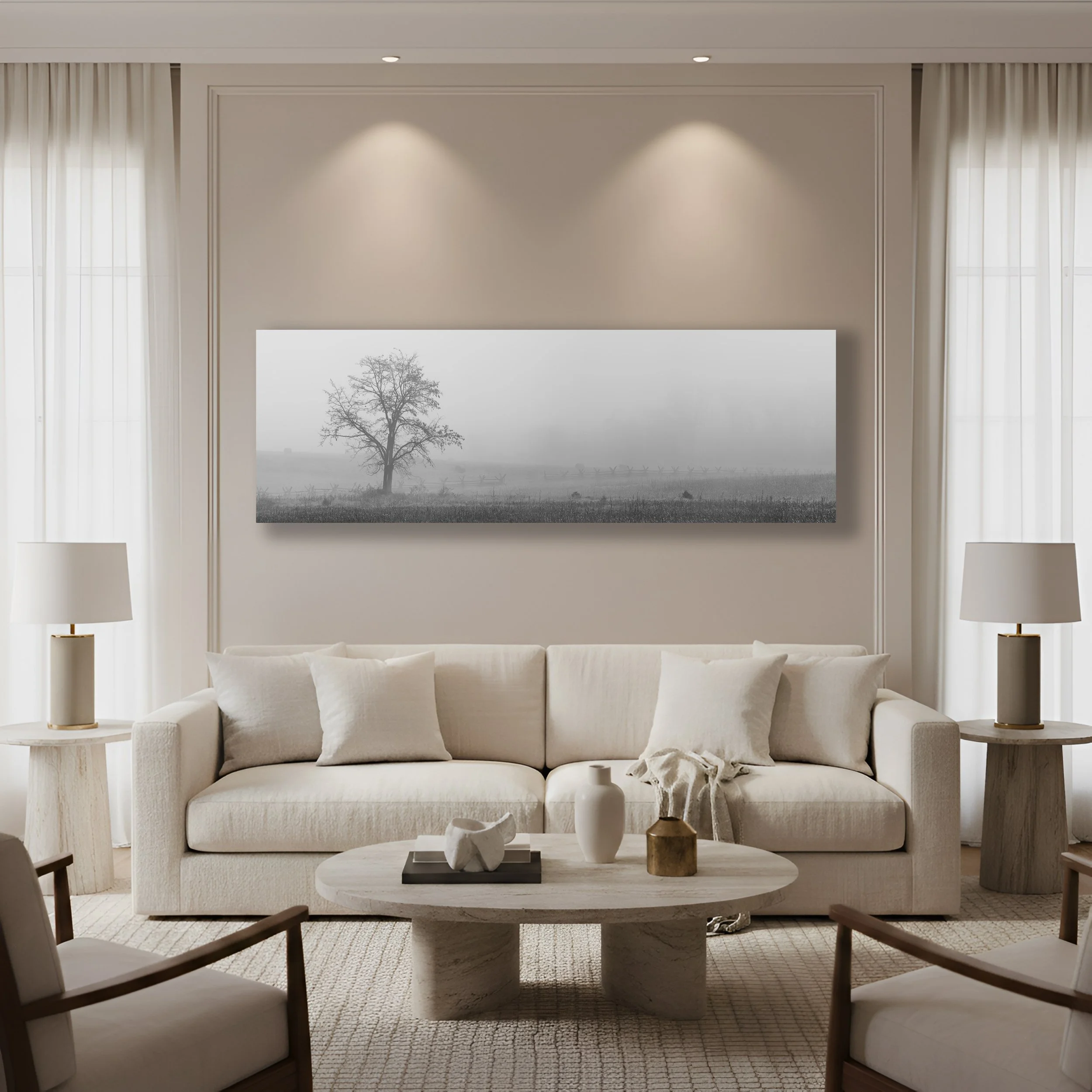
“Solemn” Black and White panoramic black and white image of a lone tree in a field in dense fog. “Solemn” as a composition has tons of negative space giving it almost a minimalist sculptural quality. The tones of the black and white image makes it universally placeable and doesn’t compete with color palettes.
The Most Important Filter of All
We've talked about scale, materials, color theory, and lighting. These principles matter, they're the foundation of thoughtful design. But there's one filter that matters more than any technical guideline:
How does the photograph make you feel?
Fine art nature photography is an investment, but more than that, it's something you'll live with every single day. It should do more than match your decor, it should move you. Perhaps it reminds you of a place that changed you, or maybe it simply gives you a sense of peace after a long day. When you look at a piece and it takes your breath away, that's your answer.
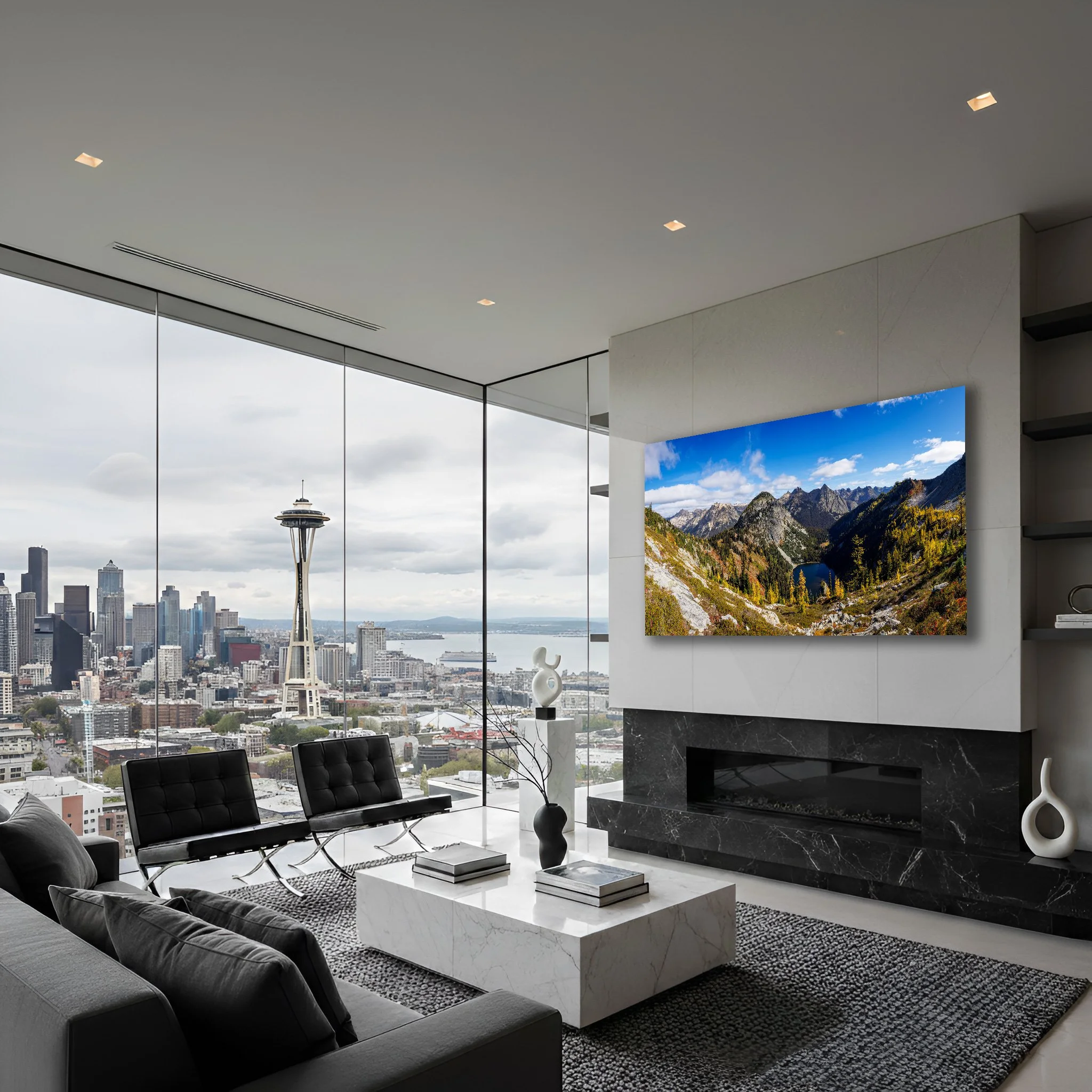
“Maple Pass” Panoramic ring from the mountains of the North Cascades during the fall with golden larches dotting the landscape. “Maple Pass” works great for autumn and transitional season interior refreshes.
Bringing It All Together
Choosing the right nature photography for your living room doesn't have to feel overwhelming. The process is quite simple when you approach it with intention. Just remember these four main points:
Scale: Go larger than you think you need. Aim for that 60-75% coverage to create true presence rather than the postage stamp effect.
Medium: Choose a material that aligns with your aesthetic. Whether that's the three dimensional depth of acrylic, the luminous glow of metal, or the classic warmth of framed paper.
Mood: Select a landscape that matches the energy you want in the room. Bright and open, moody and intimate, or abstractly modern.
Lighting: Honor your investment with proper lighting. Doing this allows the colors and details to shine the way they were meant to.
When you combine these elements with your own emotional response, when you choose a piece that genuinely speaks to you, you create more than a beautifully designed room. You create a sanctuary. A space that reminds you to slow down, to reconnect with the natural world, and to find stillness in the midst of our chaotic modern lives.
Your walls shouldn't just be filled. They should inspire reverence. They should bring the soul of the wild into your home.