
Why Earth Toned Nature Art Belongs on Your Walls in 2026
We live in a world that is increasingly loud, fast, and disconnected from the natural world. Our homes should be our sanctuary. Too often though, our walls are filled with cold sterile nothing. Stark whites, blank grey. These spaces look like they've been staged for a real estate listing rather than actually being lived in.
Something is shifting in 2026 and I think it's long overdue.
Interior designers are calling it warm minimalism. I'd call it a return to what actually matters. Bringing the quiet grounding energy of the natural world back inside with us. Not through clutter or through cheap seasonal trends, but through intentional and meaningful art that makes you feel relief the moment you walk into the room.
Beyond "Sad Beige" — The Colors That Actually Breathe Life Into a Space
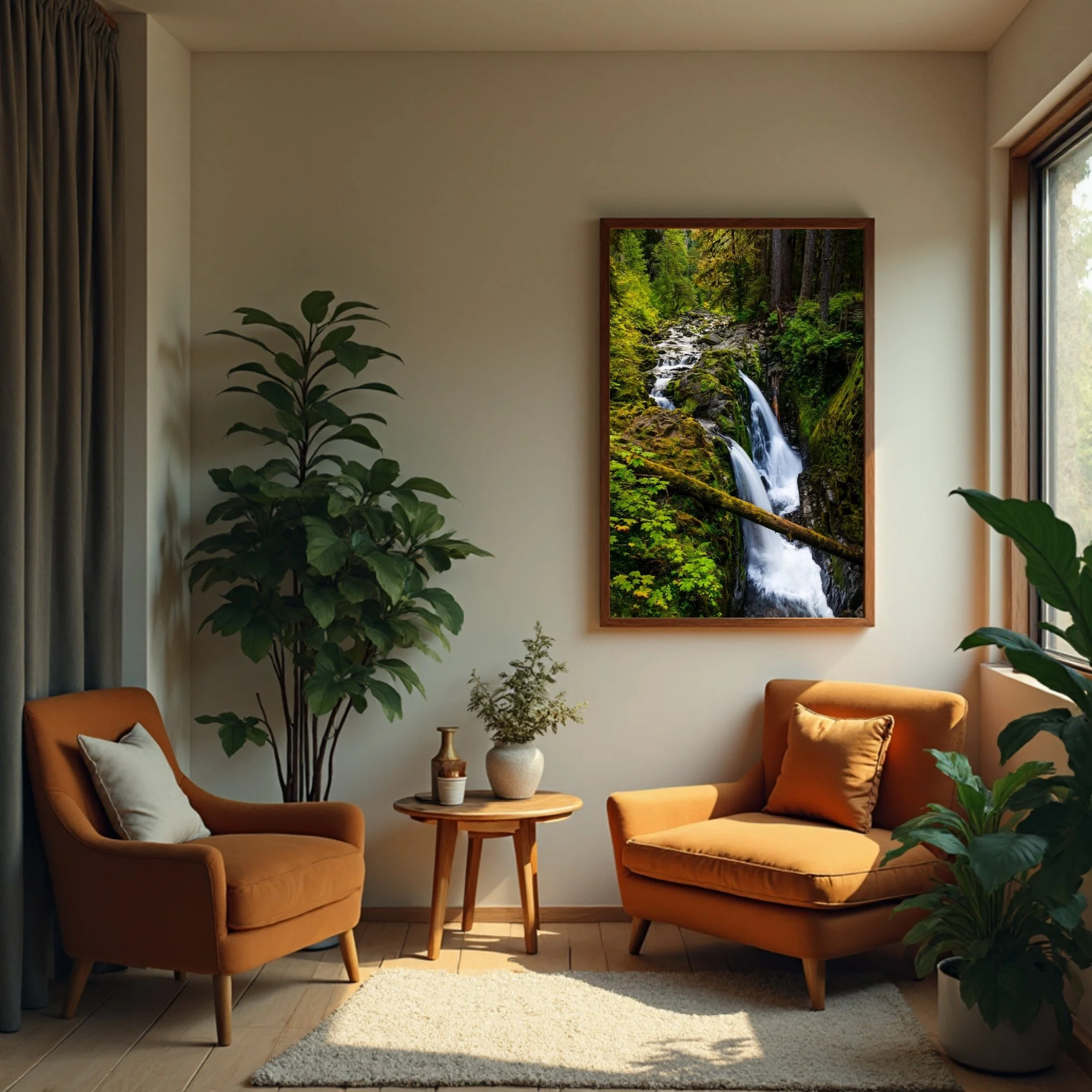
“Sol Duc Falls” Running at a lower level just before the autumn rains, only two sections are flowing over the edge. “Sol Due Falls” green tones go perfectly with the warm furniture colors creating a corner oasis.
For years minimalism meant an absence of color. White walls, grey furniture, the visual equivalent of a waiting room. People began calling it "sad beige," and they weren't wrong. A space without warmth isn't peaceful, it's empty.
The palette that's resonating right now pulls directly from the earth itself. Terracotta and clay carry the warmth of handmade pottery. The feeling of sun baked desert earth, of something that feels like it has history. Sage and deep moss do what spending actual time in a forest does. They quiet the nervous system and remind you that something much older and steadier than your inbox exists just beyond your door. Ochre and raw umber cast a permanent golden hour glow. The kind of soft amber light that makes everything feel a little more human.
There's real science behind why these tones work. Exposure to nature inspired greens and warm earth tones has been shown to lower cortisol levels by up to 18%. Your nervous system recognizes these colors. They signal safety and rest. They tell some ancient part of your brain that you are somewhere worth stopping.
The Art That Belongs in This Space
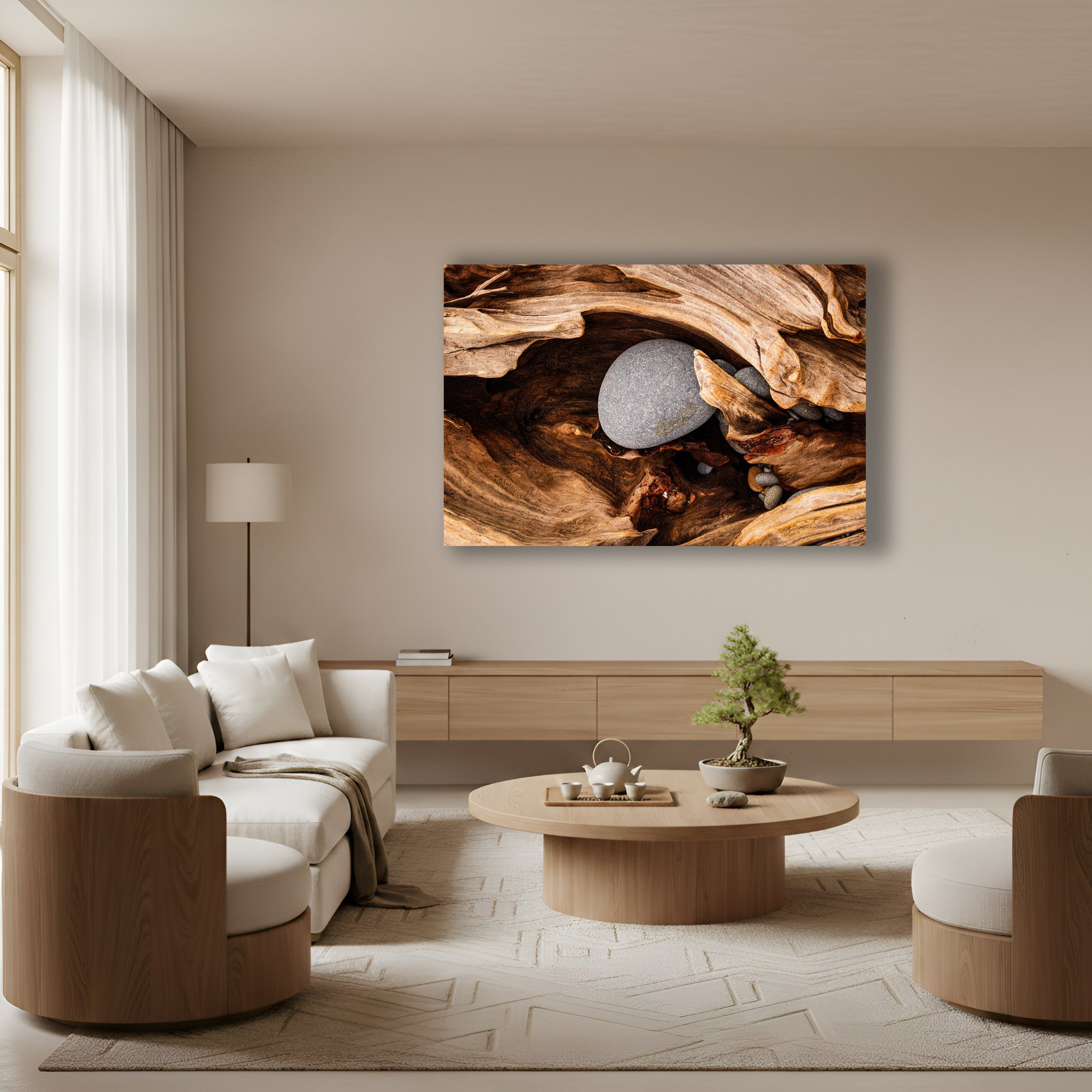
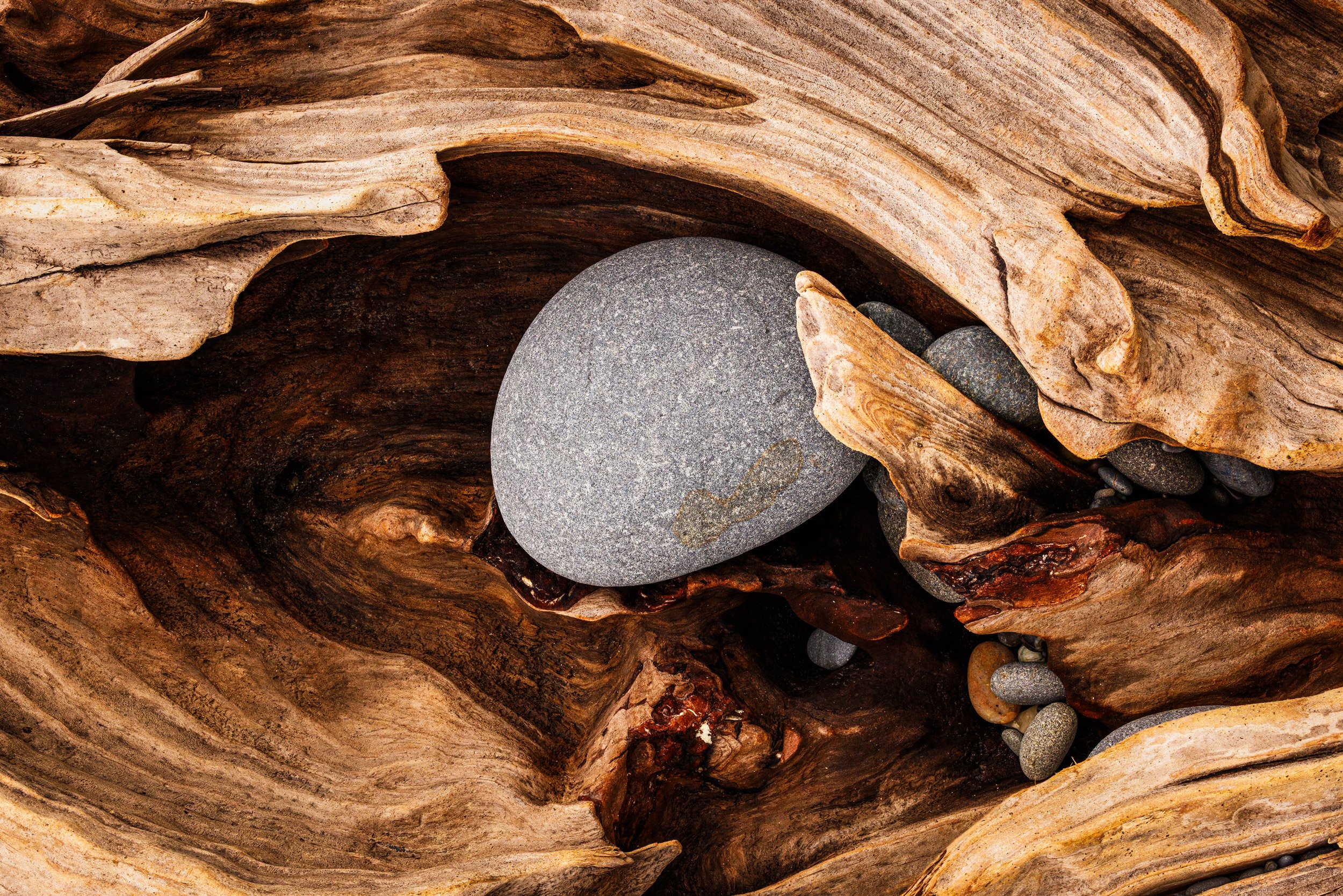
“Guardian’s Embrace” The piece of driftwood embraces the rocks inside a hole in the log. The visual language of “Guardian’s Embrace” allows your eyes to wonder around the textures of the wood and stones.
In 2026, the nature prints worth hanging aren't illustrations from a field guide. They're art that makes you feel something. Images that invite your eyes to slow down and wander rather than scan and move on.
The styles I'm seeing resonate most deeply are the ones that honor nature's own visual language. Abstract botanicals replace rigid botanical drawings with something that feels alive and in motion. Macro photography brings you face to face with the texture of moss, the grain of stone, the quiet geometry of sand. These close up views remind you that the natural world is endlessly intricate if you're willing to look. And then there are the fractal patterns. The Fibonacci sequences that spiral through a sunflower head, a nautilus shell, a breaking wave. Your brain recognizes these patterns before you consciously register them. They create an instinctive sense of order and peace.
What all of these have in common is that they ask you to be present. Not to scroll past but to stand still and look.
What the Art Is Made Of Matters
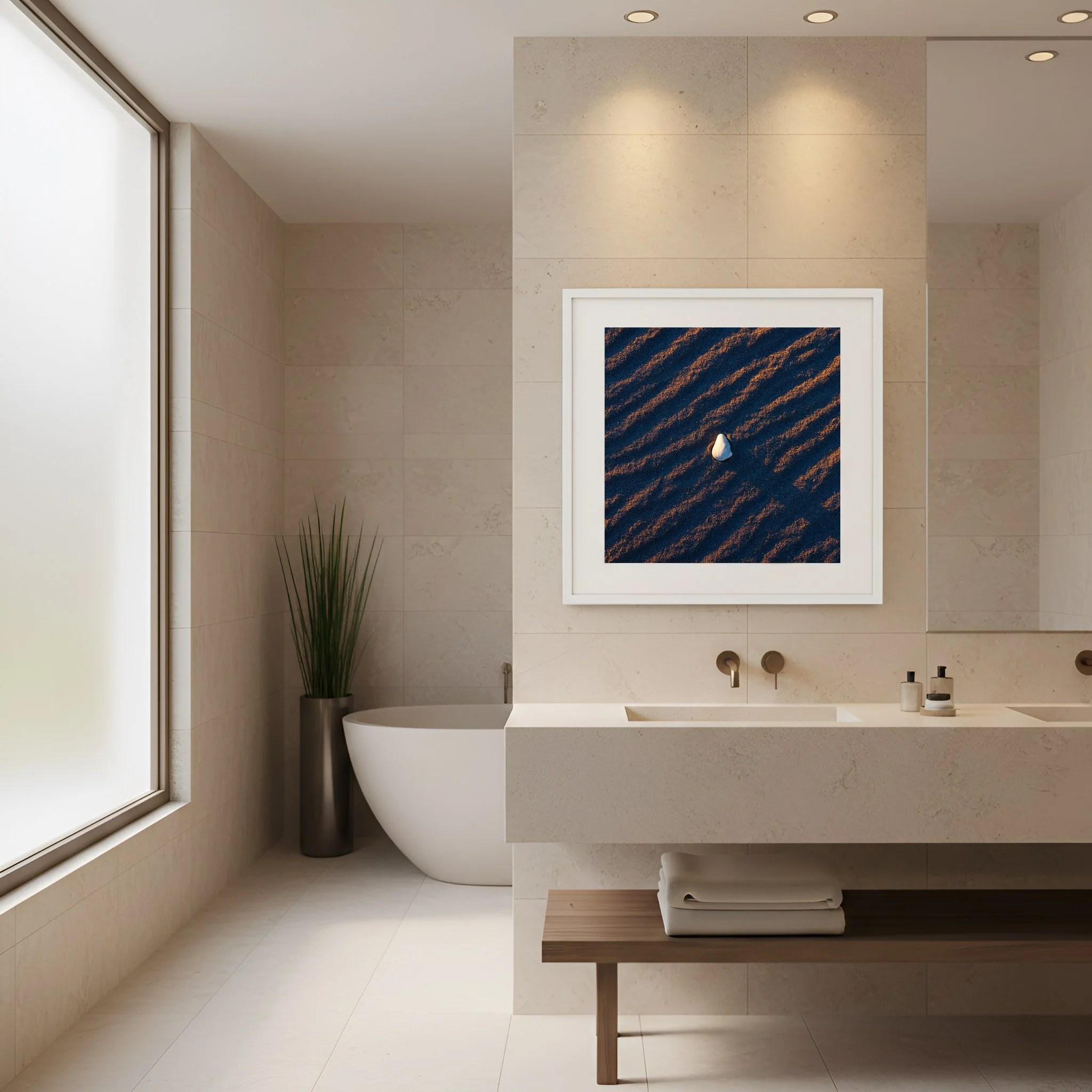
“Held By The Light” A lone shell sits on ripples of sand as sunrise illuminates the gentle ridges in the sand. “Held By The Light” brings nature’s textures and colors into the bathroom.
A print that celebrates the natural world should be made with respect for it. This is something I feel personally. It's why I use only museum grade materials and donate 5% of every sale to conservation.
The broader industry is catching up. Hemp paper which requires a fraction of the water conventional paper demands and grows rapidly without depleting the soil is becoming a standard for quality fine art printing. Soy based inks replace petroleum derived chemicals with biodegradable alternatives that actually produce richer longer lasting color. And frames are being stripped back to their raw material. White oak left in its natural sandy state or smoked walnut allowed to show its true warmth. No heavy lacquers or plastic veneer. Just the wood as it actually is.
When the entire piece, the image, paper, ink, and frame honors the natural world, it stops being décor and starts being a statement about what you value.
How to Hang It
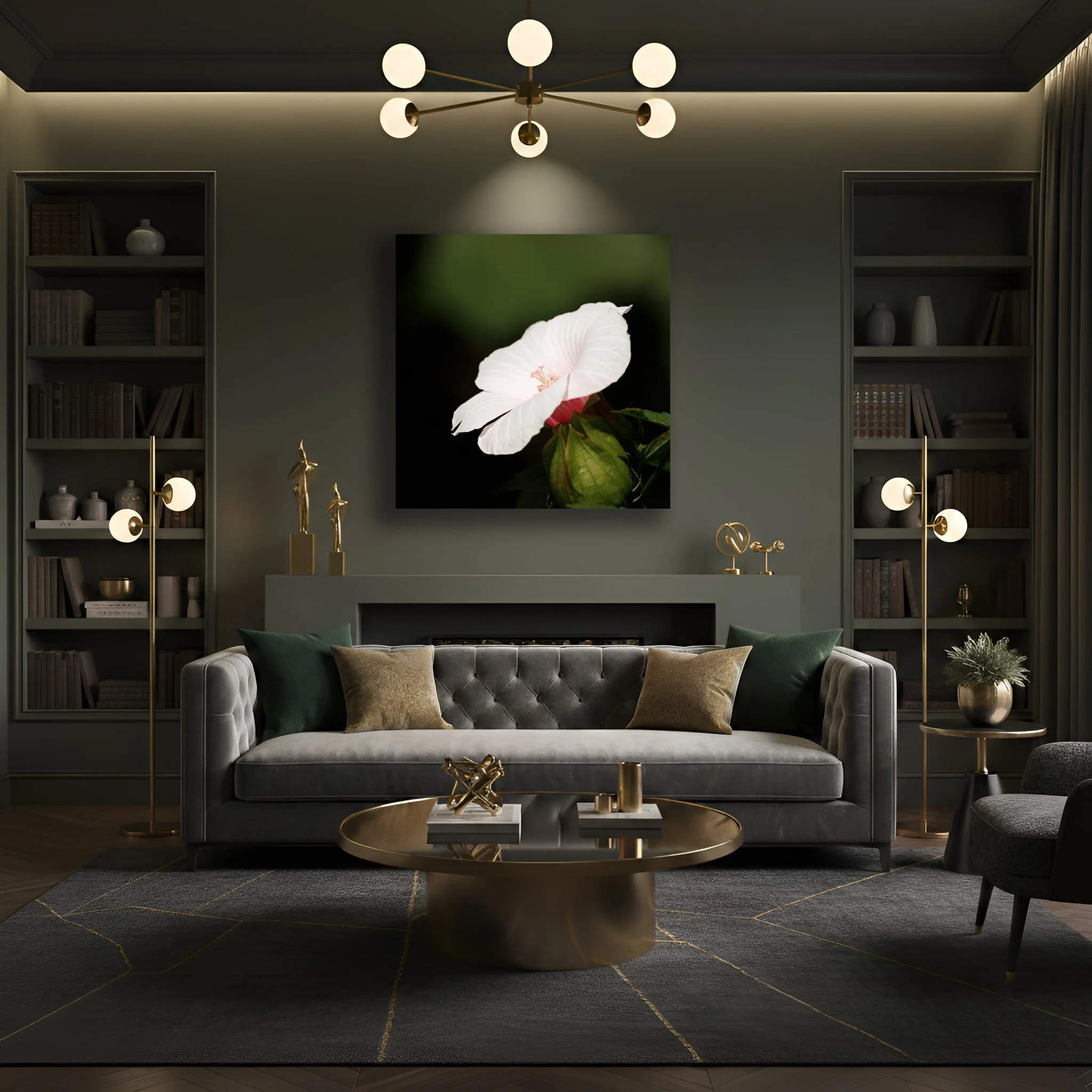
“Swamp Mallow” Soft white lines of the hibiscus stand apart from the green tones of nature surrounding the flower. “Swamp Mallow” pops with white but the greens of the background mirror the wall and decor of the room.
If you've been drawn to gallery walls, the clusters of many small prints, I'd encourage you to reconsider. That approach often creates visual noise, the opposite of what we're after. In 2026 the most powerful move is a single oversized focal point. One large piece that commands a wall and gives your eyes somewhere to land and rest.
The technique designers call "color drenching" takes this a step further. When the primary tones of your print mirror the wall behind it, the art doesn't compete with its surroundings, it becomes part of them. A terracotta print on a terracotta wall doesn't disappear. It creates a seamless warmth that wraps the entire room. The effect is less "art on a wall" and more “the room itself is the sanctuary.”
Hang your prints near soft shapes. Rounded mirrors, curved furniture, or arched doorways. The organic lines in nature photography or botanical art echo these forms naturally. The room begins to feel less like a collection of objects and more like a single coherent breath.
Fewer Things, Chosen Carefully
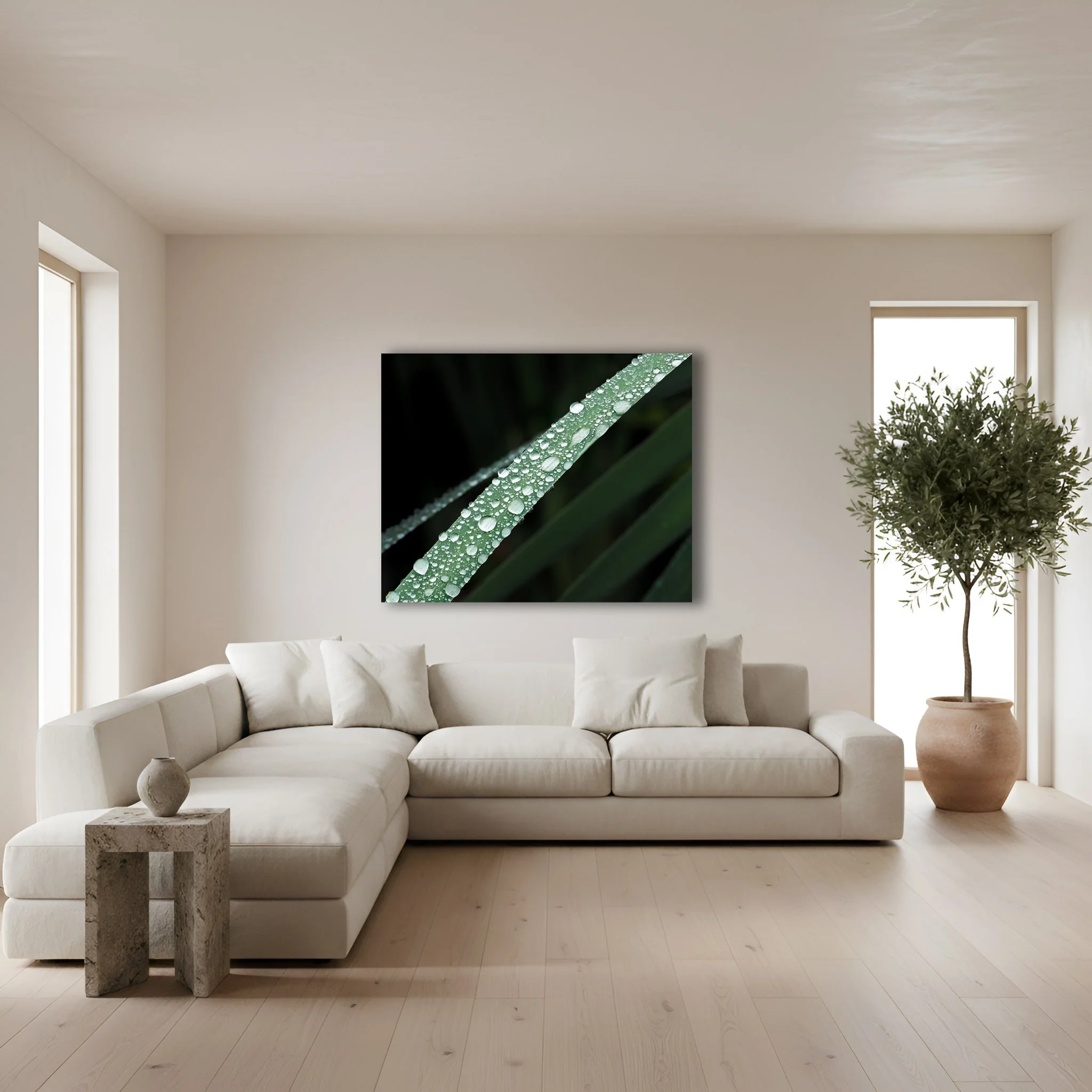
“Bejeweled” Water droplets rest on this macro shot of a blade of grass. The natural colors of “Bejeweled” will never go out of style as other fads pass with time.
The most lasting lesson of Warm Minimalism is the same one that guides how I approach my own work. Fewer and better things. One high quality meaningful print in a natural wood frame does more for a room than a dozen disposable pieces combined.
Natural colors like sage, terracotta, ochre, and clay don't go out of style because they aren't trends. They are the colors of the world that existed long before interior design was a concept and will exist long after the next aesthetic cycle fades. When you choose art rooted in those colors, in natural textures, in respect for the natural world, you're not decorating for the season. You're building a space that will still feel true to you years from now.
We spend so much of our lives staring at screens under fluorescent lights disconnected from the very planet we depend on. Our homes are one of the few places where we have genuine control over the environment around us.
Hanging a piece of nature art that you chose carefully, that actually moves you, is a quiet act of reconnection. It's a window to the wild when you can't be out in it. It's a reminder that every time you walk past it, that the world is still extraordinary and still worth protecting.
That's what great nature photography should do. Not just fill a wall but fill the room with something that matters.
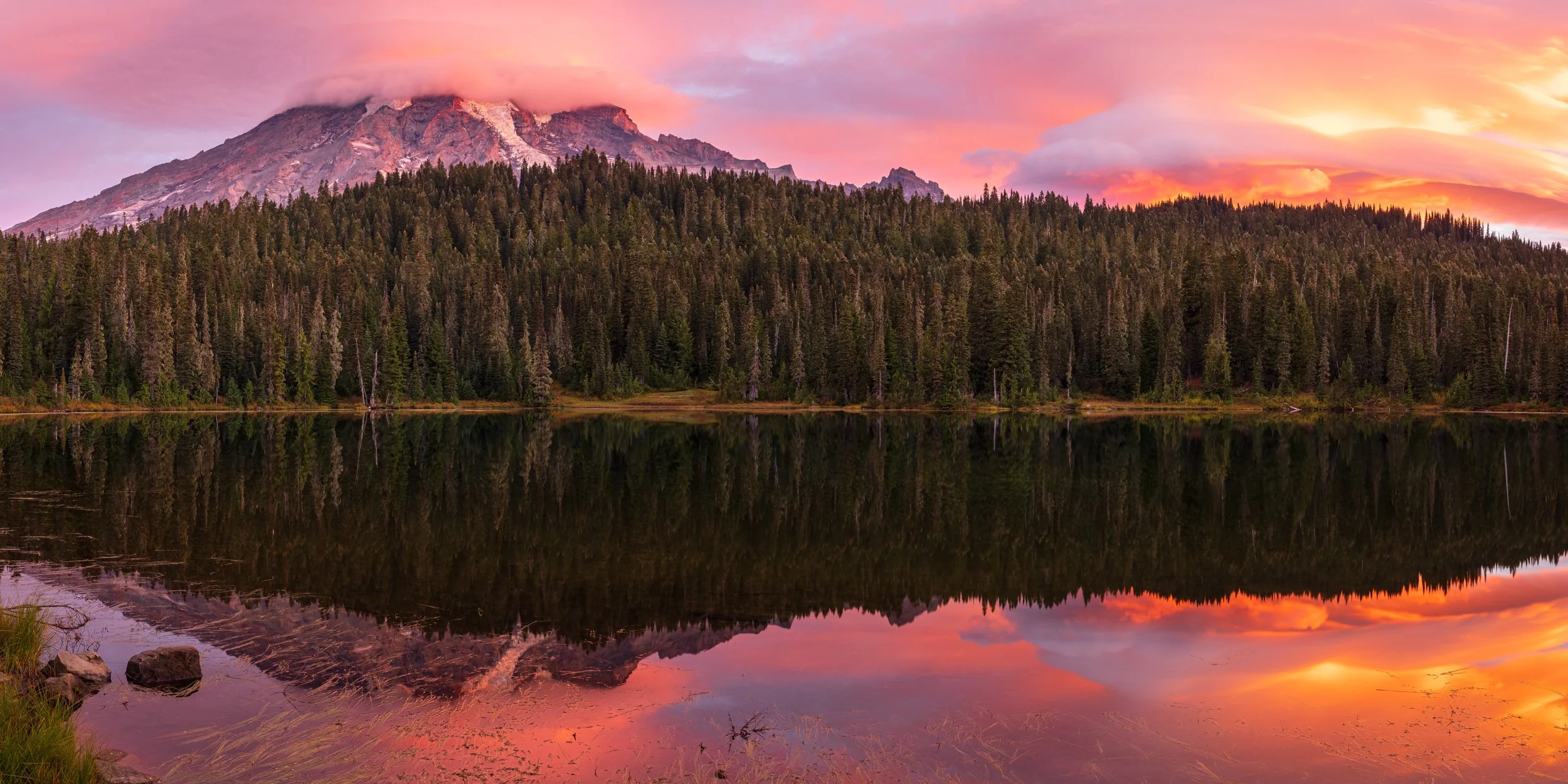
About the Photo: Crowned By Dawn
I keep two scratch off maps in my office. One for states and one for National Parks. I had one glaring section of my map that I had wanted to cross off for a long time. That area was the Pacific Northwest, Washington and Oregon. I decided that I was going to fly out to Seattle and cross two states and three National Parks off my list. I gave myself two weeks to capture the essence of the Northwest. That seemed like a lot of time but looking back, it wasn't enough. I spent a couple months planning everything I wanted to see. All the driving and the places to stay. I decided the end of September into October was the best time to go. I knew I was putting myself up against the rainy season but the thoughts of seeing fall color at Mount Rainier and the golden larches in North Cascades were worth the risk. One thing I didn’t take into account was that the Government was going to shut down a few days after I arrived which brought a lot of unknowns. At the time, I wasn’t sure if that meant the parks would close and I’d have to scramble to come up with other plans or not. Luckily the parks stayed open and I could see everything I wanted.
With that background out of the way, here is how “Crowned By Dawn” came to be and how it almost didn’t happen.
I flew out to Seattle on the night of September 26. By the time my flight arrived, I got my rental car and I made it to my hotel, it was almost midnight. I was tired from that five hour flight and just wanted to get some sleep. I figured I had two weeks, I didn’t need to rush my first morning. Plus the forecast was calling for 100% clouds. there was no shot of a sunrise happening.
The stress of the unknown with the Government shutdown and the fact that I was still on Maryland time, I woke up early. I lied in bed contemplating what to do. I took my time leaving the hotel but I decided to head to Mount Rainier so I could at least see the park if it did shutdown in a couple days. I had a two hour drive to get there and I’d be arriving right around sunrise if I was lucky. As I got to the park gates it was still dark. The trees were thick so I didn’t know what I was arriving to. The further I drove into the park, the more the trees opened up. I noticed that the sky was starting to get some color. Oh no, did I blow my shot at sunrise? A little bit of panic was going through my head but I knew I still had a shot.
I pulled into a parking spot at Reflection Lake. The sky was gaining more color on the horizon. I quickly gathered my camera bag and tripod and headed towards the lake. I tried going down a path but it was blocked off for restoration. Oh no, I’m losing more time. The sky is getting brighter. Colors are getting stronger. I turn around and find another way down to the shore. I find a nice quiet spot to sit up my tripod. I got my camera mounted and suddenly the sky erupted in pinks and rose golds all around Mount Rainier. The lake sat perfectly still living up to the name Reflection Lake. Interesting clouds hung in the sky between Mount Rainier and the sunrise so I lined up a panoramic shot and the rest is history. “Crowned By Dawn” was born.
All the stress of the morning, the panic, the lack of sleep, all worth it and I’d do it all again for a sunrise like that morning. I’d love to hear your thoughts about my photo. Also tell me your story about a time you almost missed a shot but pulled it off. Comment below and let me know.
How to Choose a Large Statement Nature Print for Your Space
That blank wall isn’t just empty, it’s waiting.
A large statement nature print has the power to transform a room from a place you simply live in to a space that actually moves you. This is the essence of biophilic design, not decoration but reconnection. And in an era when our homes have become everything, an office, a refuge, a sanctuary, the art we choose to live with matters more than ever.
But choosing the right piece can feel overwhelming. Scale, color, framing, and placement all play a role. This guide will walk you through each one so that when you finally hang that print, it feels less like decorating and more like coming home.
Start with Scale — It’s Everything
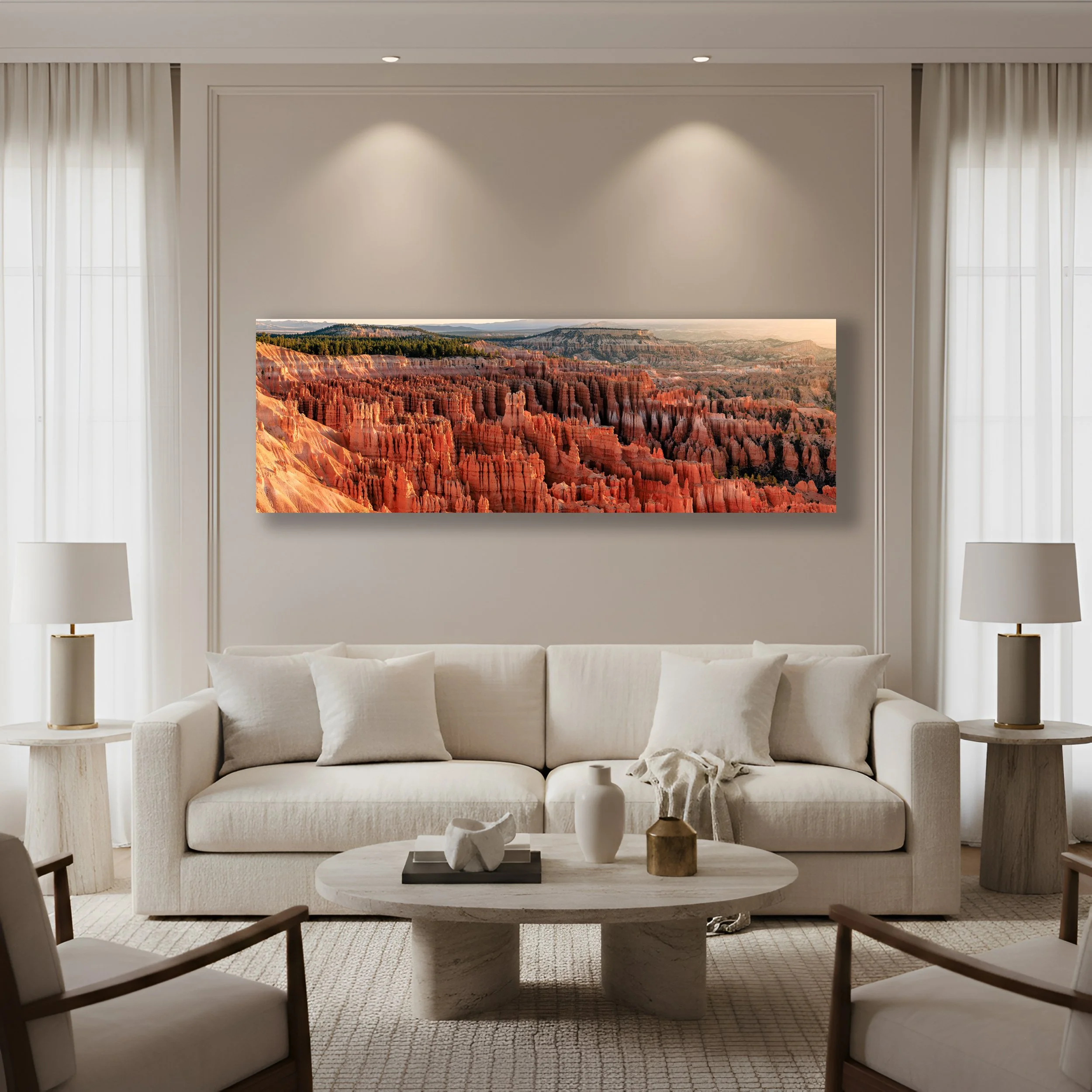
“Symphony of Stone” The first light of sunrise illuminates the orange hues of the Bryce Canyon Amphitheater. “Symphony of Stone” delivers a warm earthy palette perfectly aligned with the current trend toward organic interiors.
The most common mistake people make when choosing wall art is thinking too small. A print that’s too modest for the wall it occupies will always look like an afterthought. It will float, lost and disconnected, rather than anchoring the room the way a true statement piece should.
Here’s a simple principle to carry with you. Your art should cover roughly 60 to 75 percent of the available wall space. If you’re working with an open expanse of wall, multiply its width by 0.60. That’s your minimum size. Anything smaller and the room will feel unresolved.
When you’re hanging art above furniture such as a sofa, a bed, or a credenza, let the furniture set the proportion. Your print should span approximately two thirds of whatever sits beneath it. A 90 inch sofa calls for a print around 60 inches wide. That relationship between object and art is what creates a sense of visual balance. It shows intention.
And don’t overlook orientation. In a room with high ceilings, a vertical portrait print draws the eye upward lending the space even more height and drama. In a long low room, a horizontal landscape fills the wall with the same sweeping breadth as the scene it depicts.
Before you commit to anything, do this. Grab a roll of blue painter’s tape and outline the exact dimensions of the print you’re considering directly on the wall. Live with that rectangle for a day. Sit on the couch, stand in the doorway, look at it from across the room. If it feels too small then go larger. If it dominates then scale back. The tape test has saved more collectors from regret than any measuring app ever will.
Consider the Feeling You Want to Live With
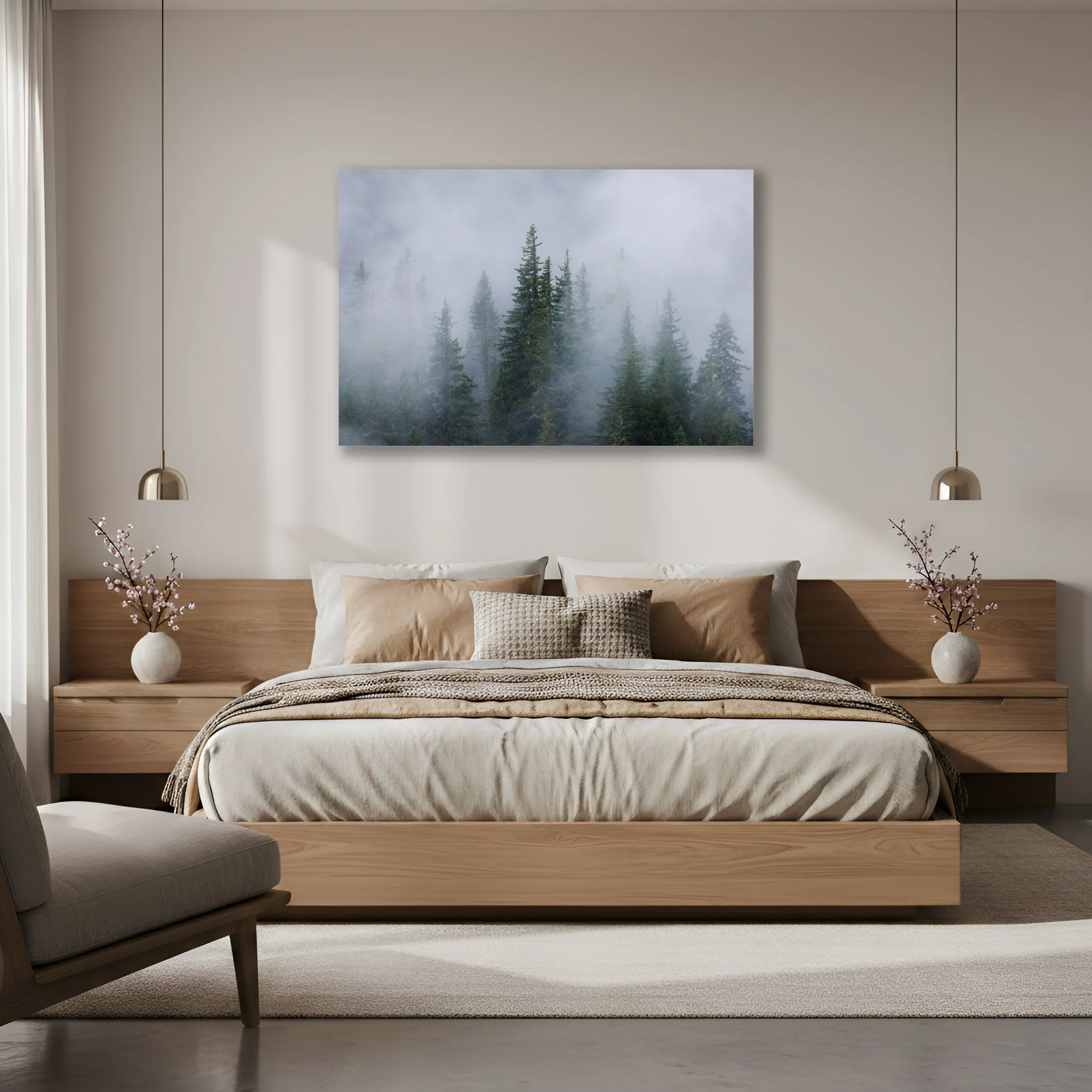
“Evergreen Dreams” Fog moves in and out of an evergreen forest in the Pacific Northwest. “Evergreen Dreams” muted grey and green tones along with meditative verticals brings a deeply calming mood to your bedroom.
Every great piece of art makes you feel something. Before you choose a subject ask yourself this question. How do I want to feel when I walk into this room?
Some spaces call for stillness. Soft light, open sky, the quiet of a misty forest or the hush of a snowfield. Bedrooms and bathrooms thrive with this kind of imagery. The goal is rest. The goal is to exhale.
Other rooms are made for energy. A living room or entryway welcomes prints that demand attention. The electric green of a tropical canopy, the flame of an autumn forest, the vivid geometry of a wildflower in full bloom. These are conversation pieces. They invite you in.
And then there are the spaces where you do your most focused work. A home office or den benefits from something grounding. Earthy, steady, geological. The vast silence of a canyon. The weight of a mountain. These images don’t distract you, they anchor.
When in doubt look around at what’s already in the room. If your textiles are neutral, soft linens, quiet grays, then a bold and vivid print will elevate the whole space. If the room already has color and personality then a more serene image can bring balance without competition.
Works with Your Color Palette, Not Against It
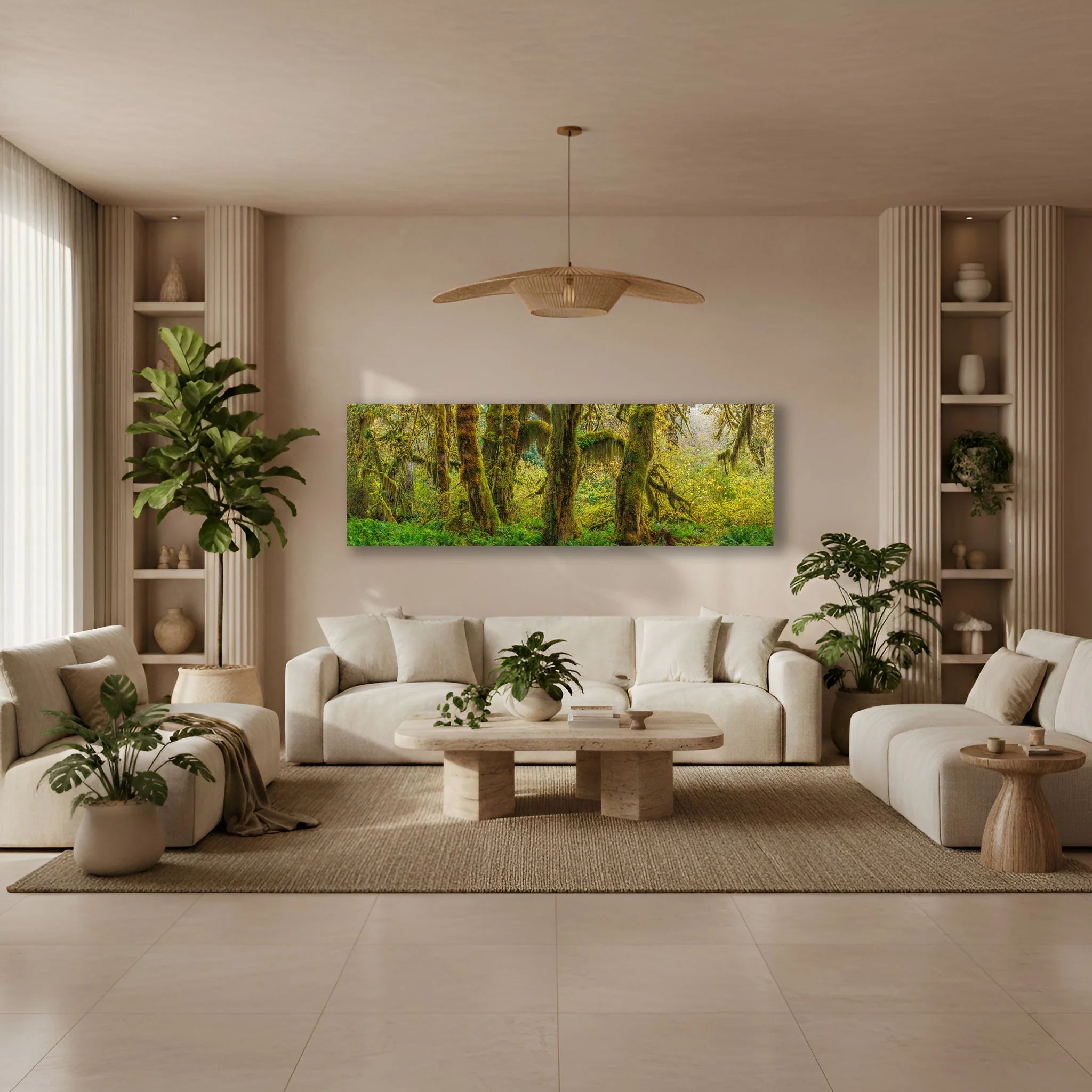
“Hall of Mosses” The lush emerald cathedral of moss draped maples in the Hoh Rainforest. “Hall of Mosses” is perfect for clients searching for nature immersive interiors and biophilic design.
Color is the language your room is already speaking. Your print should join that conversation, not interrupt it.
If you want your art to become the undeniable focal point of the room, look for colors that contrast with your walls. A deep green forest print on a warm terracotta wall doesn’t just coexist, it vibrates. That tension between opposites is what makes a room feel alive.
If you’re after something more cohesive, more quietly elegant, look to the colors already present in your rugs, throw pillows, and curtains. A stormy coastal print paired with navy blue textiles doesn’t shout, it harmonizes. The room feels as though it was designed all at once with purpose.
And if your space is already rich with color, there’s something to be said for a beautifully rendered black and white print. The absence of color isn’t a limitation, it’s a choice. Black and white nature photography offers extraordinary texture and depth that complements virtually any palette. It’s the piece that works with everything precisely because it doesn’t compete with anything.
Here’s a simple trick. Photograph your room on your phone and hold it beside the screen as you browse prints. If the colors make you pause, if something in you responds then trust that instinct.
Choose Materials That Honor the Image
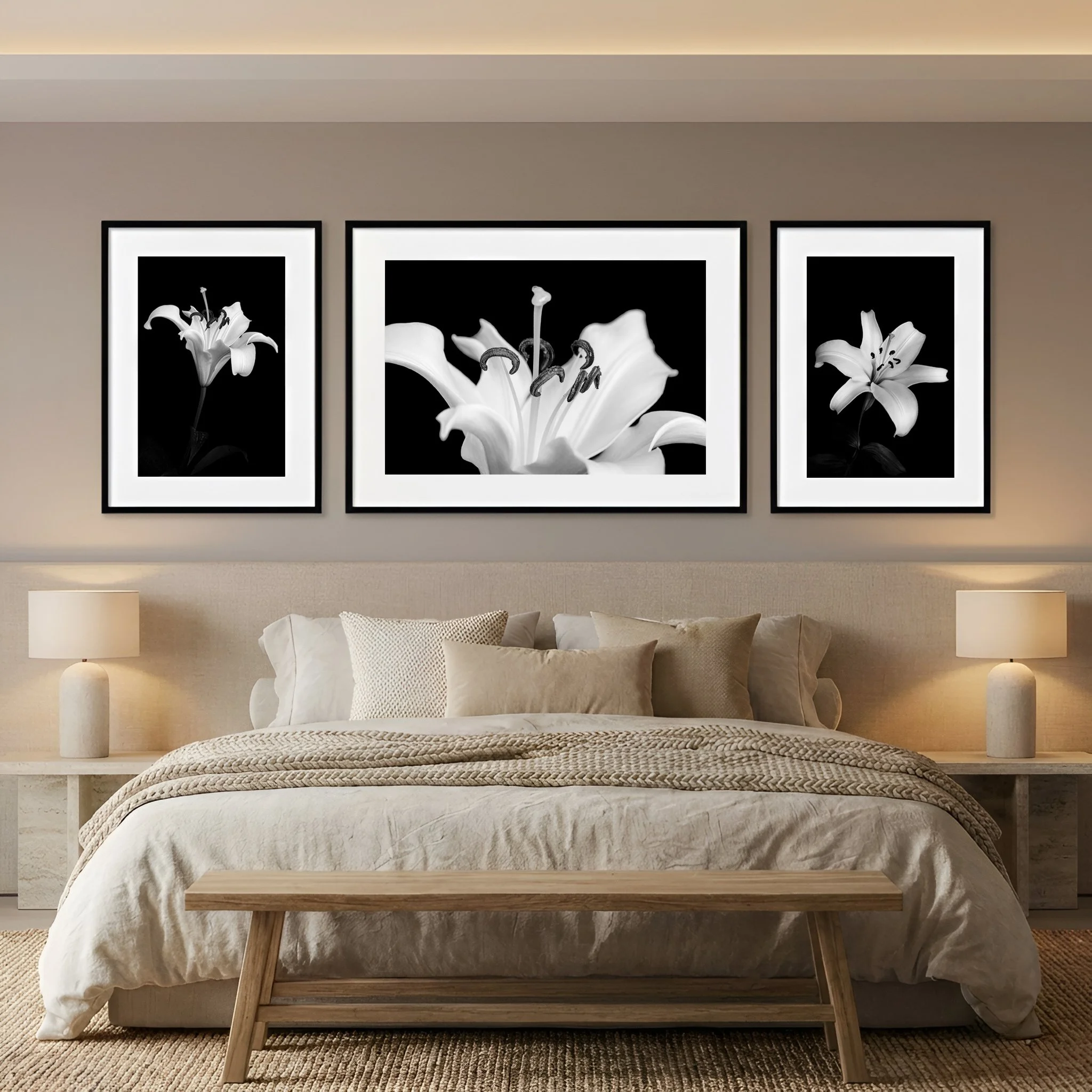
“Form of Lily Triptych” Three distinct photos tell the story of a lily. The shape and the details that make up the form of the flower. “Form of Lily Triptych” shown here printed on fine art paper, mated and framed above the bed, bring an inviting and peaceful mood to the bedroom.
The photograph is only part of the experience. The material it’s printed on shapes how you engage with it every single day.
A fine art paper print framed behind museum glass carries a sense of permanence and craft. It suits a traditional space or a clean modern minimalist room with quiet walls and considered furniture. There’s a warmth to paper, an intimacy. You’re aware that you’re looking at something made with care.
Metal and acrylic prints are a different experience entirely. Colors run deeper, luminosity increases, and the image seems to glow from within rather than simply sit on the wall. These finishes suit bold, high-definition images. A mountain lake or a sunset that feels almost unreal. They’re sleek, durable, and remarkably easy to live with.
One note on lighting. If your space receives a lot of natural light or has bright overhead fixtures, be thoughtful about reflective surfaces. Glossy glass and high sheen acrylic can catch the light in ways that obscure the very details you fell in love with. In a sun drenched room, a matte finish is your ally.
Place It with Intention
Height matters more than most people realize. In museums, curators follow a simple standard. The center of every piece hangs at 57 inches from the floor. This is average eye level for most people and it works because it creates a natural, comfortable relationship between the viewer and the image. Art hung too high feels remote. Art that is too low loses its authority.
There is one exception. When hanging above furniture leave six to eight inches of breathing room between the bottom of the frame and the top of whatever sits beneath it. That gap is what keeps the art connected to the room rather than hovering above it.
And if you’re hanging something substantial take the extra moment to find your wall studs or use proper anchors. A statement print is an investment. It deserves to stay exactly where you intend to put it.
Trust What Moves You
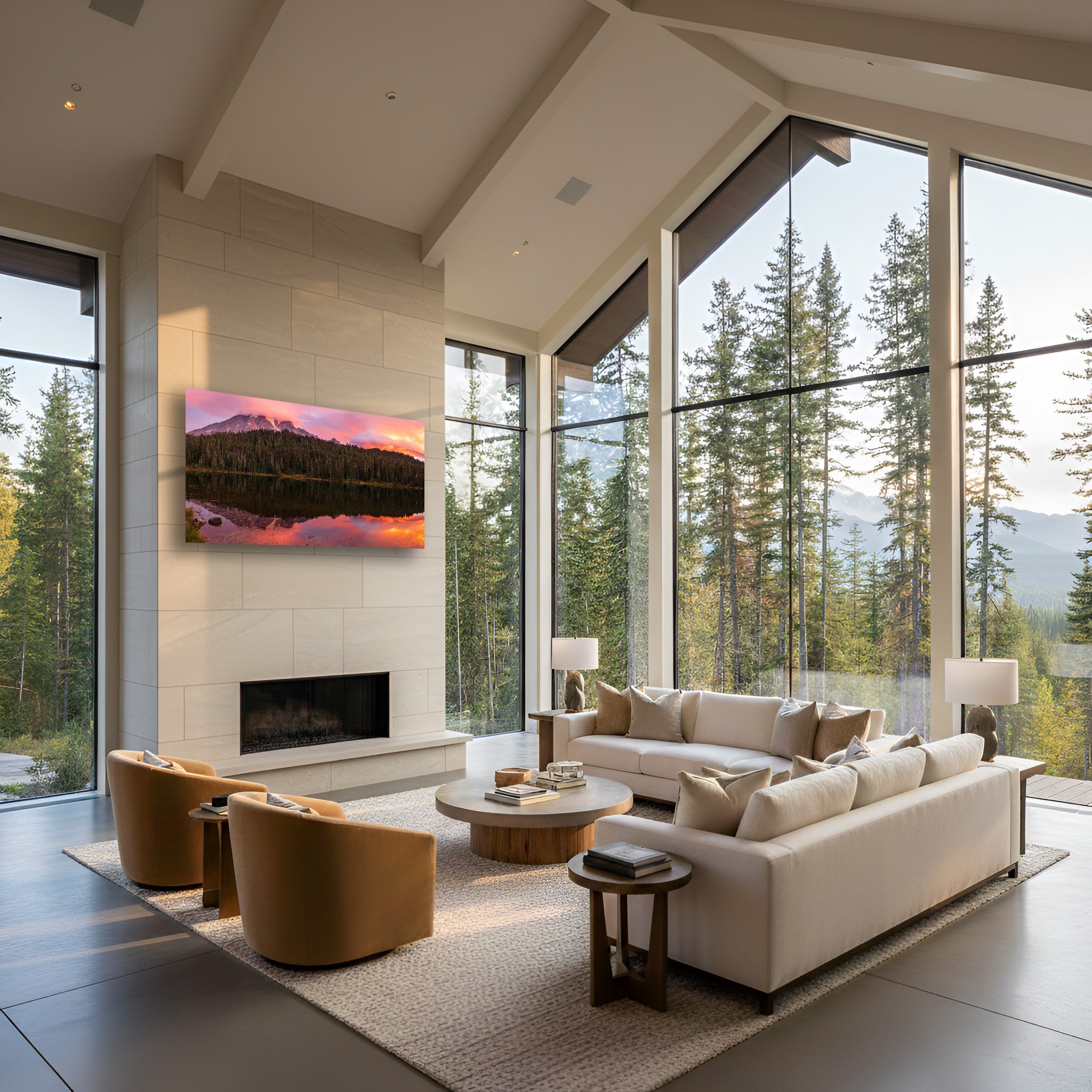
“Crowned By Dawn” Mount Rainier perfectly mirrored in Reflection Lake as the sky erupts with the pink and rose gold colors of sunrise. “Crowned By Dawn” brings presence to the room and makes a great statement piece.
The measurements, ratios, and color principles are tools, not laws. They exist to give you confidence. Not to replace your own response to an image.
If a print stops you mid scroll because it reminds you of a morning you’ll never forget. The light through the trees on a particular hike, the stillness of a lake before anyone else was awake. That recognition is worth more than any formula. Your home should reflect who you are and what you love. Not the pages of a design textbook.
The right nature print isn’t just something you hang on a wall. It’s something you live with. Something that changes the quality of an ordinary Tuesday. Something that when you glance up from whatever you’re doing, makes you breathe just a little easier.
That’s the one test that matters. When you walk into the room and your eyes find the print, does something in you settle?
If the answer is yes, you’ve found your piece.
Finding the Whisper in the Roar: The Art of the Intimate Landscape
We’ve all been there. You’ve planned a trip to that bucket list National Park or perhaps you’ve simply woken up early to catch the morning light at a local sanctuary. But nature doesn't always follow our script. The sky turns a flat, stubborn gray. The wildlife you hoped to see remains hidden in the brush.
In those moments it’s easy to feel defeated. But I’ve learned that when nature fails to cooperate, it’s usually because nature is inviting me to look closer. Instead of packing up and going home, I shift my focus. I stop looking for the roar and start listening for the whisper. I start looking for the intimate.
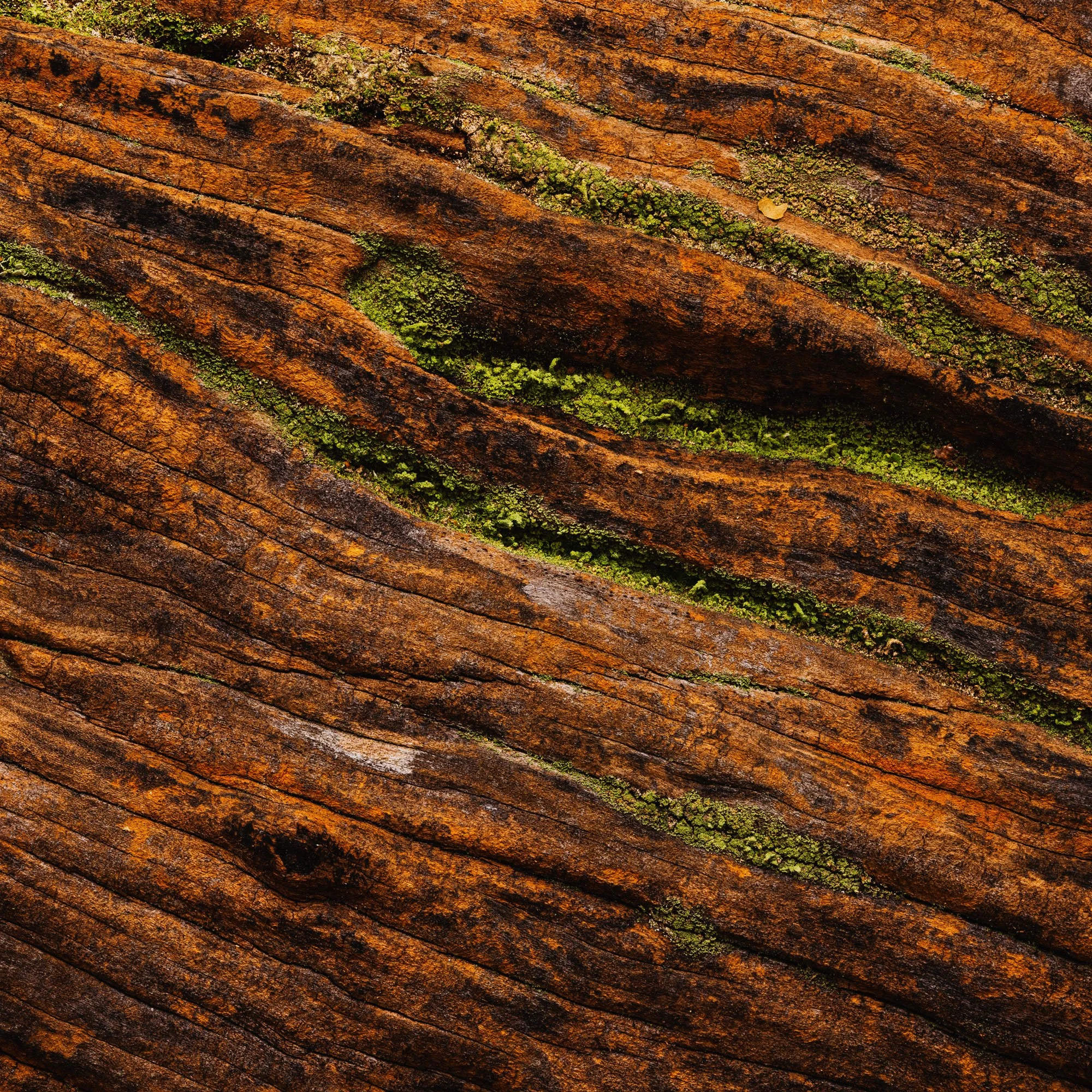
This perspective is just as valuable when the conditions are perfect. We often flock to the famous grand vistas, those iconic overlooks that have been photographed a thousand times. There is nothing wrong with capturing that big view for your own collection but if you want to create something that truly resonates you have to find the scene within the scene. Look for the abstract patterns, the interplay of light on a single ridge or the quiet textures that everyone else is walking right past. This is how you find a photo that is uniquely yours. One that makes a viewer pause and wonder, Where was this?
Last year I was in Olympic National Park. I made the trip to Rialto Beach to photograph the seastacks. When I got there I quickly realized that the shot I wanted wasn’t going to happen. The wind was fierce, waves were crashing hard and the sky was that ugly flat grey that brings nothing to a photograph. I could have let the conditions shut me down but instead I spent a moment just taking in the scene. I started looking at the driftwood that had accumulated on the beach. I found a log that had rocks that waves had deposited in a hole. What resulted wasn't a postcard of Rialto Beach. It was an intimate shot that captured the side of the beach that most just walk by.
A similar shift happened during a quiet walk through the woodlands. I was searching for birds but the forest was still. Rather than heading back to my car, I began to scan the forest floor. I found a fallen cherry tree. Stripped of its bark, all that was left was a core of twisted orange hardwood. By slowing down and working the angles, I framed the wood so the natural cracks flowed diagonally, creating a sense of movement. The contrast of the warm orange wood against the vibrant green moss felt like a conversation between the past and the present. “Written By Time” was born.
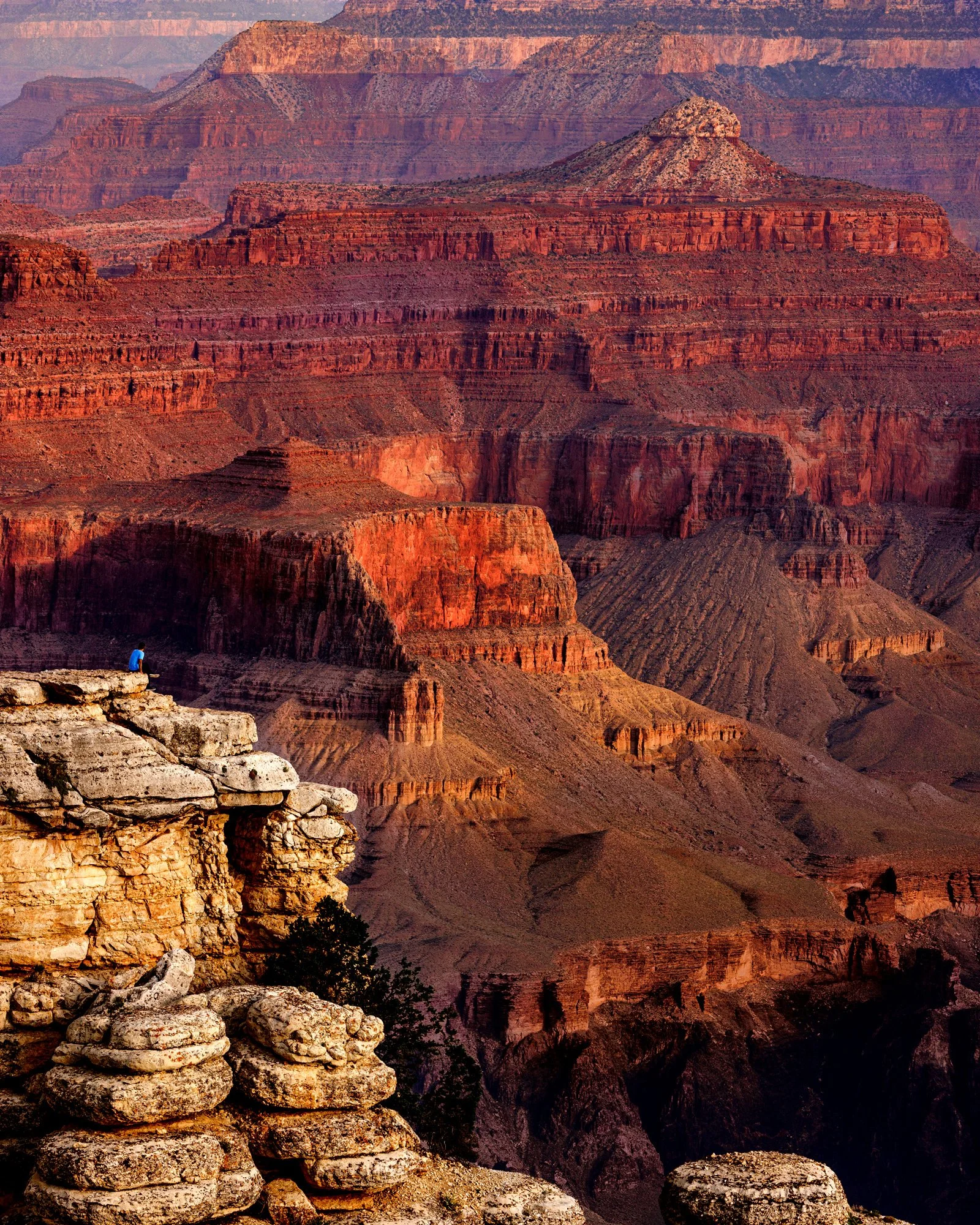
Even at a place as massive as the Grand Canyon, the “hero” shot often lacks the one thing it needs most, scale. While the morning light was hitting the canyon walls, I spotted a lone figure sitting on a cliff edge, dwarfed by the landscape surrounding him. By using my long lens to frame him against the shadowed canyon walls, his blue shirt popping against the red rock, I captured the feeling of being there how small we really are. “Feeling Small” remains my favorite photo from that trip to the Grand Canyon.
Next time you’re out with your camera, don’t let the bad conditions or missing wildlife end your day. Nature is always telling a story. Sometimes you just have to lean in a little closer to hear it. Look for those intimate scenes and you’ll often walk away with the most meaningful images of your journey.